About Clarkia franciscana F.H.Lewis & P.H.Raven
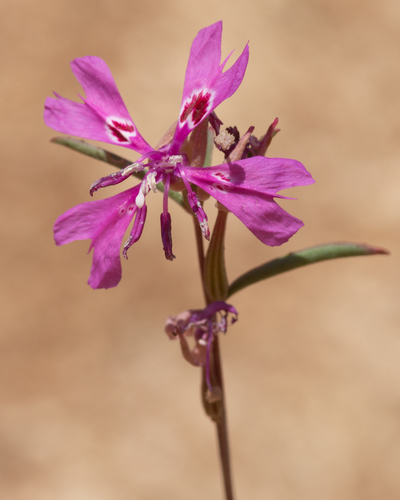
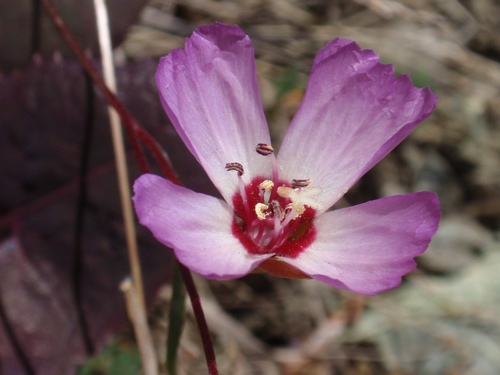
Presidio clarkia, scientifically named Clarkia franciscana, is an erect annual herb that reaches a maximum height of around 40 centimeters. It has narrowly lance-shaped leaves that grow up to approximately 3.5 centimeters long. An inflorescence sits at the top of the stem, holding both open blooming flowers and closed, erect flower buds. As the petals bloom from one side of the flower, the sepals remain fused together. The small corolla is bowl-shaped, with petals that reach up to 1.3 centimeters in length. The petals are wedge-shaped with mostly flat tips, colored lavender-pink. This color is darkest at the petal tips, lightening to nearly white at the base, where a deep red spot is present. This plant is self-pollinating. Population sizes vary from year to year, and sometimes no plants are visible at all, as the seed bank remains dormant until growing conditions improve. Clarkia franciscana is a federally listed endangered species. It has two populations located in San Francisco on land protected from development, though these populations are still impacted by multiple threats, including invasive plant species, trampling, and vegetation landscaping. The three known Oakland populations are likely remnants of a single original population that was fragmented by development in this heavily altered urban habitat. The largest of the three Oakland occurrences is partially protected within Redwood Regional Park, while the other two are found on privately owned land that is proposed for development. Housing construction is planned for this site, with less than one acre left undeveloped as a compromise between developers and environmental advocates.