About Clangula hyemalis (Linnaeus, 1758)
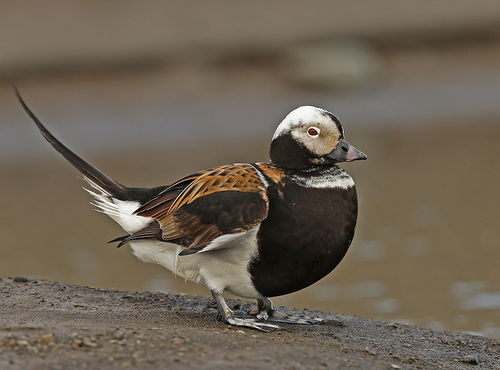
This species, Clangula hyemalis (Linnaeus, 1758), commonly called the long-tailed duck, has distinct plumage patterns that change with age, sex, and season. All adult long-tailed ducks have white underparts, while the rest of their plumage changes through a complex moulting process. Adult males have a long pointed tail that measures 10 to 15 cm (3.9 to 5.9 in) in length, and a dark grey bill marked with a pink band across it. In winter, the male has a dark cheek patch set against a mostly white head and neck, a dark breast, and an almost entirely white body. In summer, the male’s head, neck, and back are dark, with a white cheek patch. Adult females have a brown back and a relatively short pointed tail. In winter, the female’s head and neck are white with a dark crown; in summer, the entire head is dark. Juveniles look similar to adult females in their autumn plumage, but have a lighter, less clearly defined cheek patch. Male long-tailed ducks are vocal, producing a distinctive musical yodelling call that sounds like ow, ow, owal-ow. Long-tailed ducks breed on tundra habitats across northern Eurasia, including Russian Siberia, Kamchatka, Karelia, the Faroe Islands, Finland, parts of southern Greenland, Iceland, and Norway, as well as across northern North America, including Alaska and northern Canada. In winter, they occur on and near large bodies of seawater, such as the Northern Pacific Ocean, the North Atlantic Ocean, Hudson Bay, and the North American Great Lakes. Small numbers can also be found on the Missouri River in winter. Long-tailed ducks are gregarious, and form large flocks during winter and migration. They feed by diving to catch mollusks, crustaceans, and some small fish. While they usually feed close to the water’s surface, they are capable of diving to depths of 60 m (200 ft). The Audubon Society Field Guide to North American Birds records that they can dive to 80 fathoms, which equals 150 m (480 ft). Like velvet scoters, they use their wings to assist with diving, which allows them to dive much deeper than most other duck species.