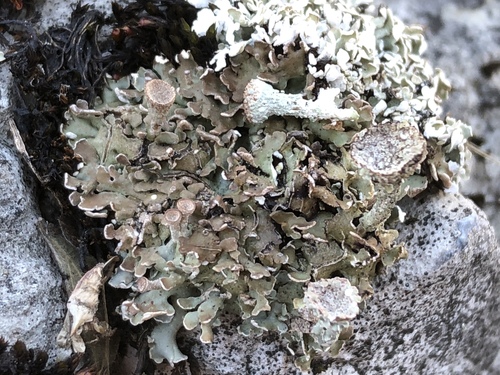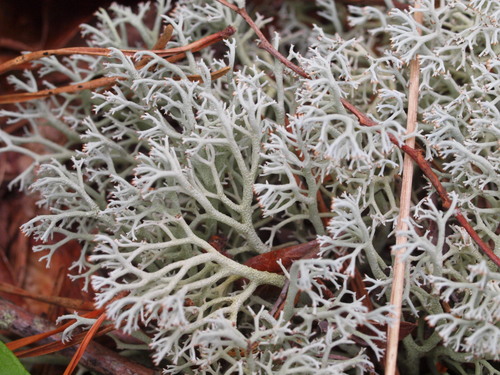
About Cladonia rei Schaer.
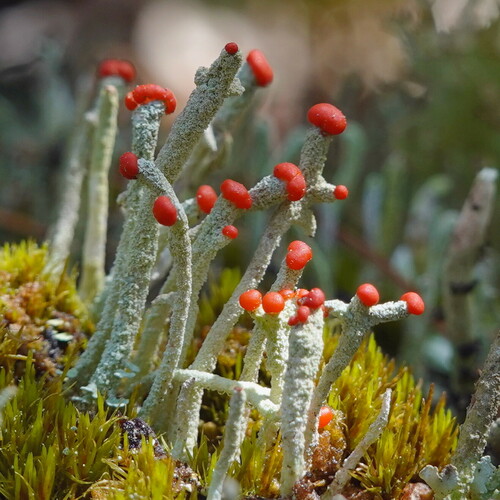
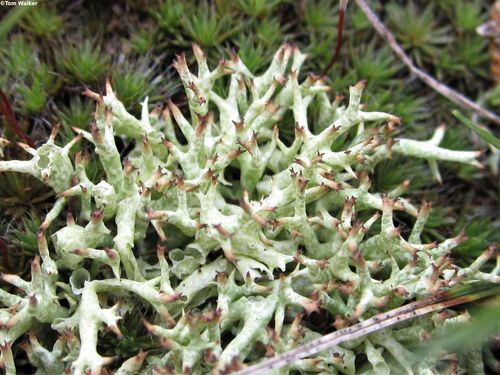
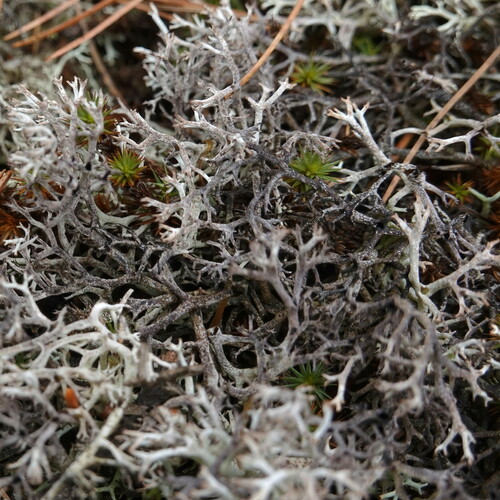
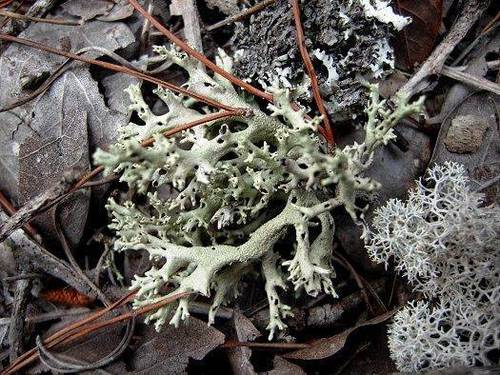
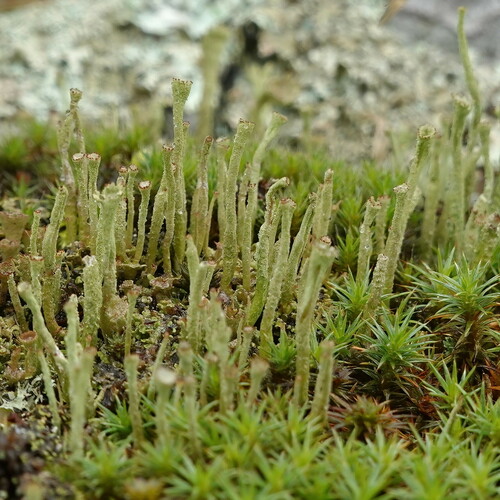
Cladonia rei Schaer. has primary squamules that are small and inconspicuous, and often disappear over time. Its podetia are gray-green to olive, sometimes taking on a brownish hue, and are slender. The upper half of the podetia is covered in coarse or fine soredia. Podetia measure 2–9 cm tall and 1–2 mm thick, and can reach up to 3.5 mm in thickness. They form narrow cups that are symmetrical, or more often lopsided, and proliferate from the cup margins to take on a shape resembling a star or a magic wand. Pale to dark brown apothecia are commonly found on these proliferations along cup margins. Spier and Aptroot noted that there is substantial individual variation between Cladonia rei specimens: specimens can range from nearly unbranched to cup-shaped, from slender (less than 1 mm thick) to robust (reaching 5 mm thick), and from low (average height below 2 cm) to tall (height over 5 cm, clearly taller than surrounding Cladonia species). The distribution of these forms across chemotypes is largely similar overall, and no consistent differentiating characteristics have been identified. Growth in contaminated sites can alter the growth and development of Cladonia rei thalli, sometimes producing features that do not match the standard taxonomic definition of the species. This morphological change has been specifically documented in Cladonia rei. Cladonia rei is a terricolous (soil-dwelling) lichen. It more rarely grows on rotting wood, and there are very few records of it growing on other substrates including rock, plastic, old straw, and mosses growing over rock. It prefers open areas with low humus content and a more or less neutral soil pH, and typically grows in dry, sunny locations such as grasslands, heaths, and wastelands. It also commonly grows on limestone cliffs and limestone meadows, and can be found in disturbed areas including road embankments, gravel pits, and house ruins. It is a pioneer species, able to quickly colonize bare ground, especially in disturbed, human-modified habitats. In some cases it can grow on impoverished soil with high heavy metal content. In Krompachy, Slovakia, Cladonia rei and the moss Ceratodon purpureus were found to be very abundant on bare acid soil near copper smelters, a site where all vascular plants were severely damaged or had disappeared. The species is widespread across temperate and moderately arid regions, and does not occur in the Arctic or Antarctic. Cladonia rei was used as a case study for a large-scale biodiversity monitoring program in Alberta, Canada. Historical collections and records suggested the lichen was broadly distributed but rare in the province, but newer survey data collected by the Alberta Biodiversity Monitoring Institute shows that its distribution in Alberta is entirely limited to the dry mixed grassland, northern fescue grassland, and aspen parkland natural regions, where it is relatively common. Overall, Cladonia rei has a global range that extends to Europe, Africa, Asia, Australasia, North America, and South America. It is widely distributed across Europe, with records from Austria, Belgium and Luxemburg, Czech Republic, Estonia, Lithuania, Norway, Poland, Slovakia, Spain, and Sweden. More recently, it has been reported from Armenia, from the coastal sand-dunes of Portugal, and in 2021 from the Pyrénées-Orientales in the French Mediterranean region. Its Australasian distribution includes both Australia and New Zealand. It was reported as a new record for India in 2002, and recorded from Iran and Turkey in 2006. In the United States, some authors have considered it to be widely distributed in the northwestern part of the country, but this is likely due to misidentification with the much more common species C. ochlorochlora and C. verruculosa. Samuel Hammer notes that its actual range in this region is limited to interior localities east of the Cascade Mountains, in Idaho and Washington. Epicladonia sandstedei is a lichenicolous fungus that parasitizes Cladonia rei. In a study of oribatid mite communities associated with three Cladonia species in a heavily contaminated habitat, Cladonia rei was found to provide a good habitat for mites. Due to the high variation in its podetial growth form, and the dense coverage of propagules including corticated granules, squamules, microsquamules, and numerous non-corticated farinose-to-granular soredia, Cladonia rei has a higher surface area to volume ratio than the other studied Cladonia species. Its rugged surface texture creates more microhabitats for both mites and the organic matter particles that mites feed on. This differs from Cladonia cariosa and Cladonia pyxidata, which have less diverse morphology and support a lower diversity of oribatid mites. The photobiont partners of Cladonia rei depend to some degree on local environmental conditions. While both Asterochloris and Trebouxia algae can form an association with the Cladonia rei fungus, the presence of Trebouxia is directly linked to anthropogenic sites with technogenic substrates. The proportion of Cladonia rei specimens containing Trebouxia clearly depends on the level of heavy-metal soil pollution and the habitat type. Although Cladonia lichens were previously thought to only associate with Asterochloris, they are able to begin the relichenization process with Trebouxia under specific habitat conditions, and can form a stable association with these algae when colonizing disturbed sites.