About Cladonia rangiferina (L.) Weber
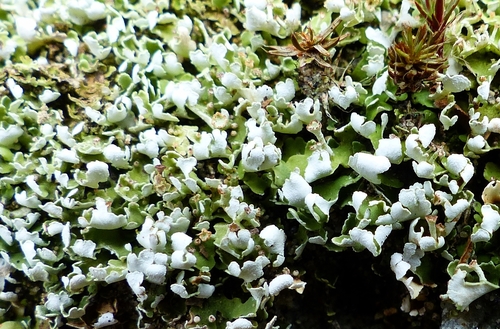
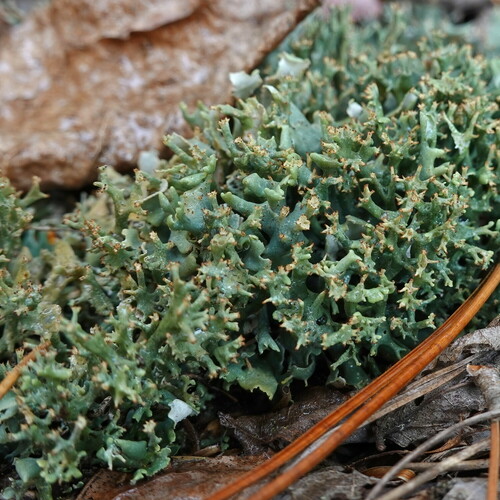
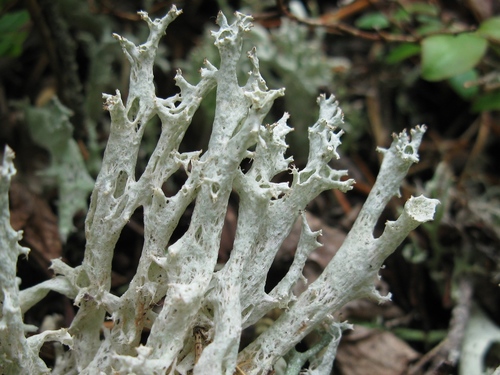
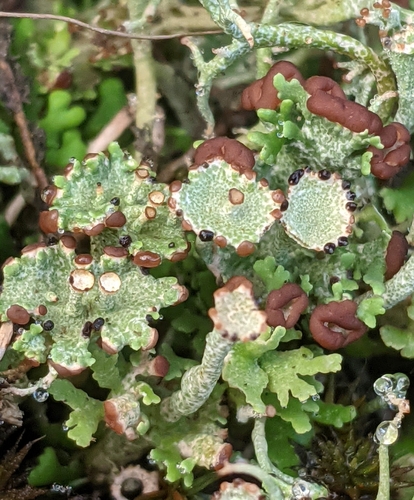
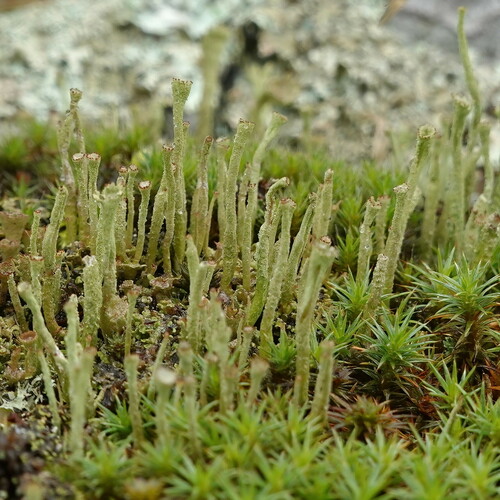
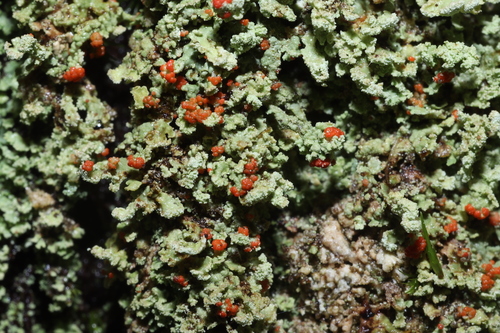
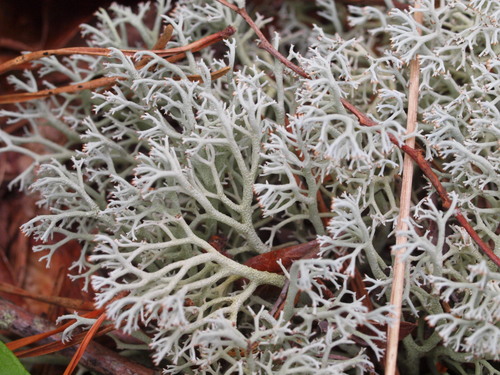
Cladonia rangiferina (L.) Weber, commonly called reindeer lichen, has fruticose, extensively branched thalli. Each branch typically divides into three or four parts, and sometimes into two; thicker branches usually measure 1–1.5 millimetres (1⁄32–1⁄16 inch) in diameter. Its colour ranges from greyish, whitish to brownish grey. This lichen forms large mats that can grow up to 10 centimetres (4 in) tall. Its branching occurs at a smaller angle than that of the related species Cladonia portentosa. It does not have a well-defined cortex, the protective outer layer covering the thallus that is analogous to plant epidermis; instead, a loose layer of hyphae covers its photobionts. The photobiont that associates with reindeer lichen is Trebouxia irregularis. When the lichen is fertile, its terminal branches often split into short umbrella-shaped clusters. The apothecia that develop here are typically positioned just below actively growing branch tips, and may be hidden within the lichen's cushion structure. Like many lichens, reindeer lichen grows slowly, at a rate of 3–11 millimetres (1⁄8–3⁄8 inch) per year. It may take decades to recover after being damaged by overgrazing, burning, trampling, or other impacts. Another distinct species that looks similar and shares the common name "reindeer lichen" is Cladonia portentosa. Cladonia rangiferina often dominates ground cover in boreal pine forests and open, low-alpine sites across a wide range of habitats, including humid open forests, rocks, and heaths. It grows on humus, or on soil overlying rock. It is mainly found in the taiga and tundra biomes, and is present in the boreal forests of Canada. This lichen has a strong tolerance for extreme environmental stresses including freezing, dehydration, UV light, and high salinity. Experiments have confirmed that the lichen continues respiration even after immersion in liquid nitrogen, severe drying, exposure to saturated salt solution, and exposure to temperatures as low as -40°C. Field studies confirm that Cladonia rangiferina produces many small apothecia when conditions are favourable, but these structures are easy to overlook. As fertile tips start forming fruiting bodies, new sterile branches grow past them to form the visible top of the lichen cushion, leaving mature apothecia hidden just below the surface layer. This growth pattern allows the lichen to continue expanding vegetatively while also reproducing sexually. At humid locations, this species often becomes fertile across many branch tips at once, and fertile tips frequently split into umbrella-like clusters that can hold multiple tiny apothecia discs around 2 mm across. Studies have found that these apothecia release abundant, easily germinating ascospores, which indicates sexual reproduction supports long-distance dispersal of the species. The fertility of Cladonia rangiferina varies with microclimate. In locations with good water access and high air humidity, lichen cushions commonly develop numerous apothecia and taller podetia reaching roughly 12 cm. In drier locations, fertile thalli are less common and podetia are shorter, measuring around 4–6 cm. A Finnish study of Cladonia rangiferina growth rate found the lichen grows 3.9 to 4.4 mm per year. It reaches its fastest growth rate in young (less than 60 years old), shadowy forests, and its slowest growth rate in old (more than 180 years old), thinned forests. Cladonia rangiferina is a known host for three lichenicolous fungus species: Lichenopeltella rangiferinae (which is named after this lichen), Lichenoconium pyxidatae, and Lichenopeltella uncialicola. Reindeer lichen is edible, with a crunchy texture. It can be soaked with wood ashes to remove its bitterness, then added to milk or other dishes, and it is a source of vitamin D. This lichen is used to make aquavit, and is sometimes used as decoration in glass windows. It is used as a traditional remedy to remove kidney stones by the Monpa people in the alpine regions of the West Kameng district of the Eastern Himalaya. The Inland Dena'ina people used reindeer lichen as food by crushing dry lichen, then boiling it or soaking it in hot water until it softens. They eat it plain, or prefer to mix it with berries, fish eggs, or lard. The Inland Dena'ina also boil reindeer lichen and drink the juice as a medicine for diarrhea. Acids present in lichens mean consumption may cause an upset stomach, especially if the lichen is not thoroughly cooked. A 2017 study found that reindeer lichen can grow on burnt soil as early as two years after a forest fire in Northern Sweden, which suggests artificial replanting of this lichen could be a useful strategy for restoring reindeer pastures.