About Cladonia floerkeana (Fr.) Flörke
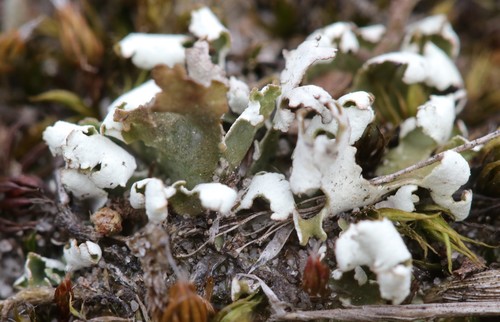
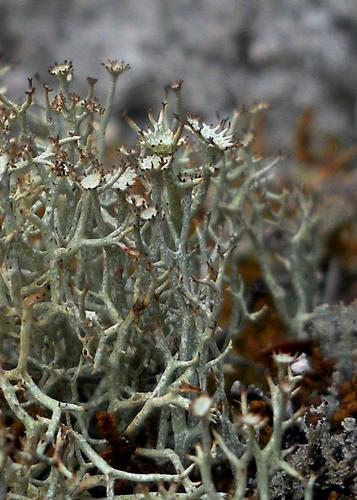
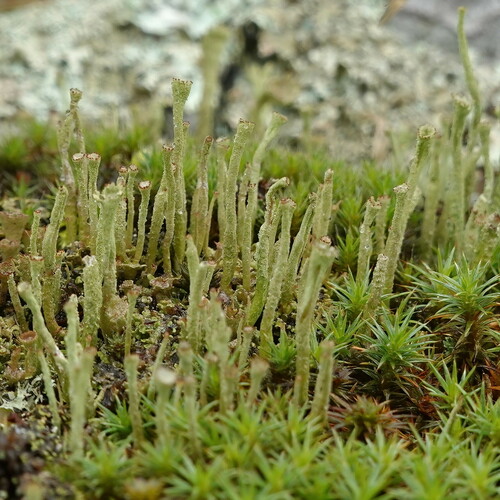
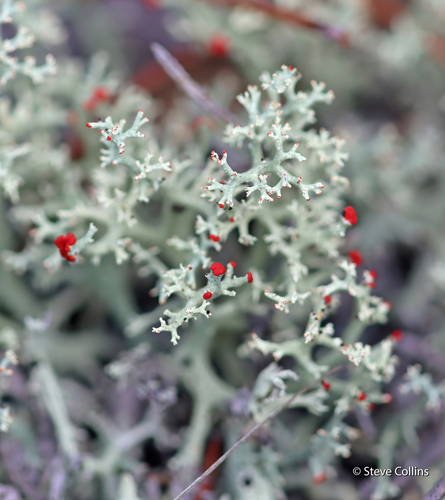
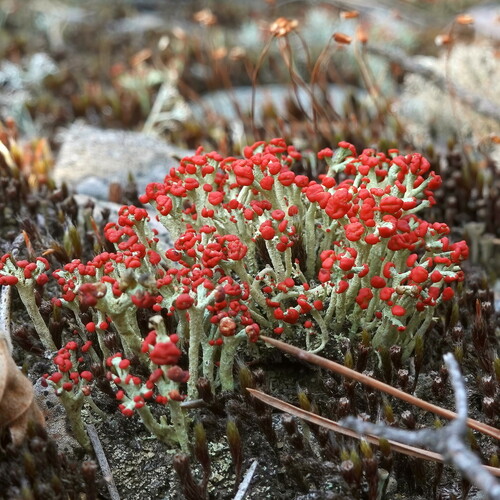
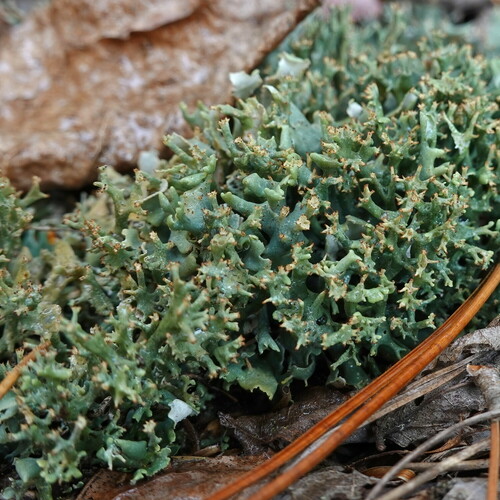
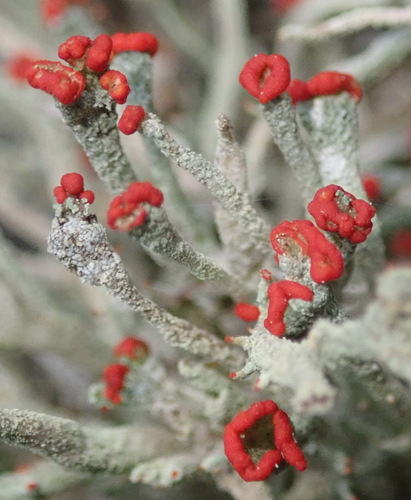
Cladonia floerkeana (Fr.) Flörke has a persistent primary thallus formed from small, lobed scale-like structures called squamules. These squamules measure 1–3 mm long and 1–2 mm wide, and they are esorediate, meaning they do not produce powdery reproductive structures known as soredia. The basal squamules are small, persistent, and often inconspicuous, with an orange tint on the lower surface towards the base. The species' secondary structures, called podetia, are common, growing up to 2 cm tall and often shorter. Podetia range from pale to dark grey, and develop a brownish tint when growing in exposed sites. They may stay unbranched, or branch sparingly near their tips. Podetial surfaces are highly variable: they may be fully corticate (covered in a thin fungal layer), partially decorticate (especially near the tips), have patches of granular soredia, or be densely covered in squamules across their entire surface. They have been described as resembling "scraggly white fingers with lumpy surfaces". Podetia grow laterally, a process that begins with splitting and enlargement of meristem tissue. This growth disrupts the symmetric isotropic growth pattern of early development, shifting to asymmetric anisotropic growth that enables branching and creates morphological variability. Microscopically, the podetial wall has three distinct layers: an upper cortex of tightly packed hyphae, an algal layer containing round or shriveled algal cells loosely associated with hyphae, and a medullary layer of loosely interwoven hyphal threads that forms a fibrous network. Soredia, which are non-corticated clumps of algae and hyphae used for vegetative propagation, start developing in the medulla and algal layers before emerging through cracks in the cortex. Meristematic regions in podetia show high developmental plasticity, changing from roughly round (subglobose) to worm-like (vermiform) or kidney-shaped (reniform) structures. This flexibility in development lets the species produce a range of podetial forms to adapt to diverse environments. Cladonia floerkeana produces small asexual reproductive structures called conidiomata, which usually form on the primary squamules and occasionally at podetia tips. These structures are black, often have red tissue around their opening (ostiole), and contain a characteristic red slime. The asexual spores, called conidia, are curved (falciform) and measure 6–9 μm long. This lichen also frequently forms apothecia, which are saucer-shaped sexual fruiting bodies 0.5–2.5 mm in diameter. Its sexual spores are oblong to spindle-shaped, measuring 8–14 by 2.5–3 μm. The photosynthetic partner (photobiont) of C. floerkeana is the green alga Asterochloris erici. Cladonia floerkeana has a broad but patchy distribution across multiple continents. It is rare in Honduras, where it has been recorded growing on wooden fences, and may often be overlooked in this region. It is also classified as very rare in Chile. In eastern North America, it occurs from Florida (where it is very rare) to Newfoundland. Its presence is confirmed in Europe and Australasia, though the full extent of its distribution is not well understood, partly due to confusion with the similar species Cladonia macilenta. Additional records confirm its presence in Melanesia (including Papua New Guinea), other parts of North and South America, Africa, Asia (including Japan and Taiwan), and Oceania (including New Caledonia, Australia, and New Zealand). The species grows on nutrient-poor acidic soils, and is most commonly found in heathlands, boreal forests, and areas recovering from disturbance such as post-fire landscapes. It grows on a range of substrates including soil, humus, rocks, and sand, and occurs occasionally on decaying wood. In Japan, it has been found growing in geothermal vent areas, where it tolerates extreme conditions: surface temperatures above 40°C, root-zone temperatures over 70°C, and soil pH between 5 and 5.5. Despite this overall adaptability, C. floerkeana is highly sensitive to changes in soil pH and is a strict calcifuge, meaning it does not grow in alkaline or limestone-dominated soils. Experimental lime treatment has been found to kill the species, confirming its requirement for acidic substrates. It has been collected at elevations between 1,800 and 3,200 metres. As a pioneer species, C. floerkeana often establishes early during ecological succession, and is part of the characteristic "cup lichen" community. Its varied podetial forms allow it to occupy niches too harsh for vascular plants or mosses, which reduces competition for this lichen. The wide range of podetial surface types, from fully decorticate to densely squamulose, lets it adapt to many different environmental conditions and substrate types. The species is more abundant in areas with low atmospheric nitrogen deposition, and it is less common in areas with high nitrogen deposition. High nitrogen deposition reduces overall lichen diversity and promotes increased algal growth that can outcompete C. floerkeana. This sensitivity to nitrogen further restricts its distribution in areas with elevated nitrogen levels. In high-nitrogen environments, C. floerkeana is often replaced by nitrogen-tolerant species such as Cladonia macilenta and Cladonia ramulosa. In low-nitrogen habitats, its ability to thrive in early succession gives it a competitive advantage. Ecologically, C. floerkeana invests heavily in reproduction, producing abundant apothecia on its podetia, which die after releasing spores. This reproductive strategy helps it rapidly colonize new substrates. Although it can tolerate extreme conditions, it remains relatively rare in geothermal vent systems, likely due to its specific habitat requirements and interactions with environmental factors such as soil texture and moisture. The fibrous medullary layer of its podetia persists even after secondary squamules shed, and may provide structural support and resilience to environmental stress, further improving its ability to grow in disturbed or extreme habitats. Its slow growth rate of around 0.8 mm per year matches its classification as a stress-tolerant organism adapted to persist in nutrient-poor and disturbed environments. The species uses a heterothallic breeding system, which requires genetically distinct partners for sexual reproduction; this promotes genetic diversity and improves its adaptability to harsh environments. The lateral growth pattern seen in C. floerkeana is thought to be an evolutionary adaptation that improves its ability to colonize and persist in challenging environments. By forming worm-like and kidney-shaped meristems during growth, the species overcomes structural constraints and gains flexibility to spread across new substrates. This flexibility in development likely contributes to its success as a pioneer species in nutrient-poor and disturbed habitats.