About Cladonia didyma (Fée) Vain.
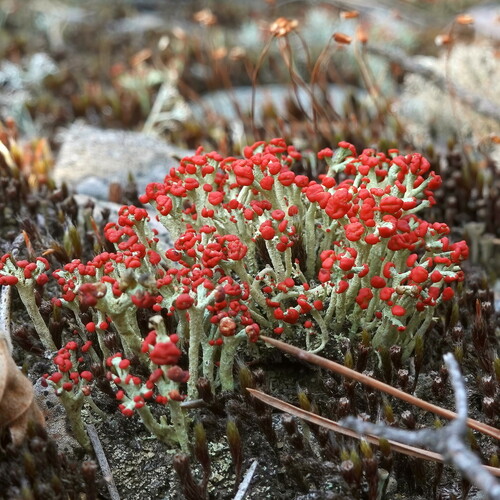
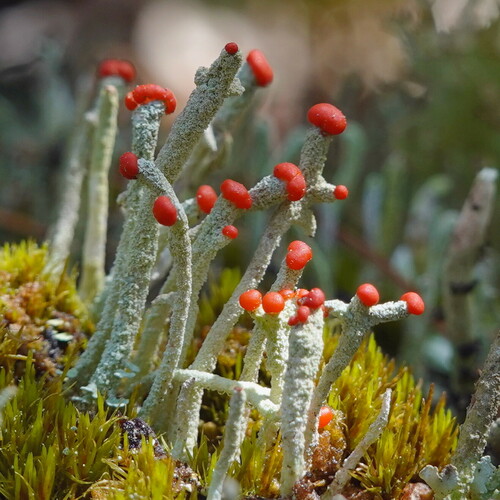
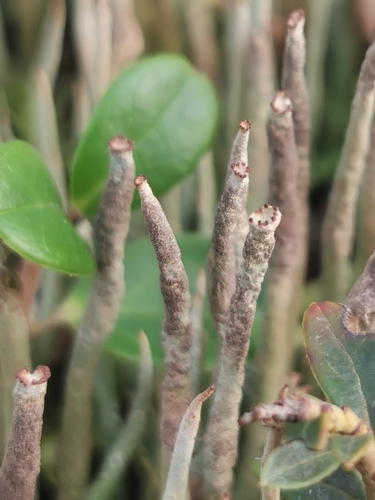
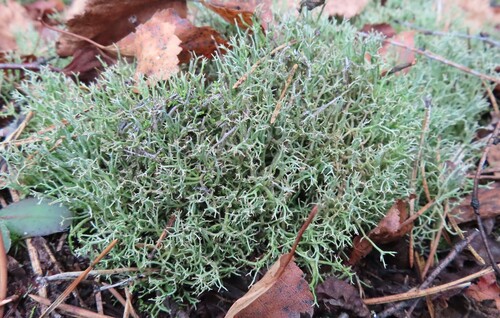
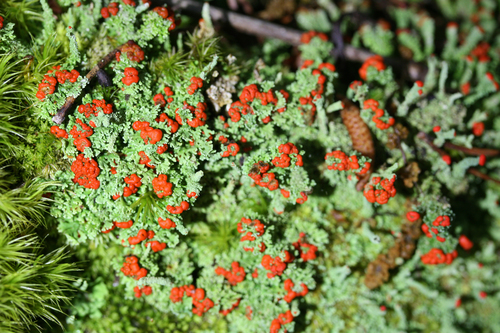
Cladonia didyma (Fée) Vain., commonly known as southern soldiers, is a fruticose lichen in the Cladoniaceae family. This lichen forms through symbiosis with a fungal partner that belongs to the Ascomycota phylum, and it produces characteristic red ascocarps that hold sexually reproductive asci. The species was first described under the name Scyphophorus didymus by Fée in 1824, and was reclassified to Cladonia didyma in 1887 by Vainio. Its scientific name draws from Ancient Greek terms: κλᾰ́δος (kládos), meaning 'branching', and Δίδυμος (didymus), meaning 'bunched', 'clustered', or 'paired'. The generic name refers to the characteristic branched structures of the Cladonia genus, while the specific epithet refers to the clusters of Cladonia didyma individuals that are often observed growing alongside other Cladonia species or other variants of C. didyma. Cladonia didyma has a wide distribution, occurring on nearly every continent and in oceanic regions across a range of environmental conditions. It can grow from sea level up to altitudes of 3400 meters, and occupies habitats from mesic to xeric forests. It most often grows on dying or decaying trees alongside other mosses and lichens, but has also been observed growing in sandy soils, on rocks, and has been detected in mycorrhizal sequencing analysis of epiphytic orchids.