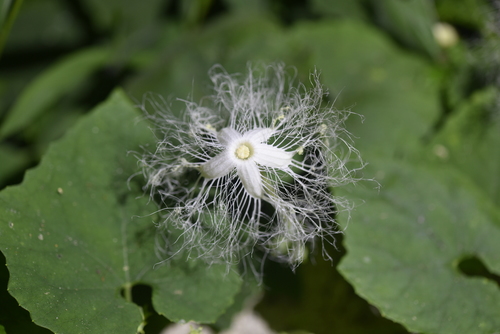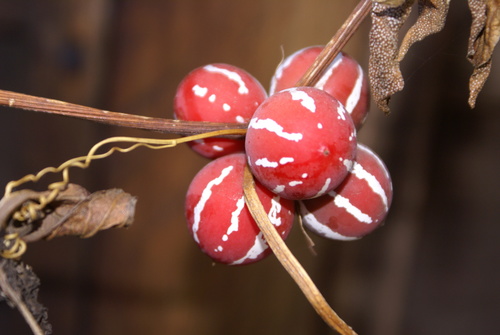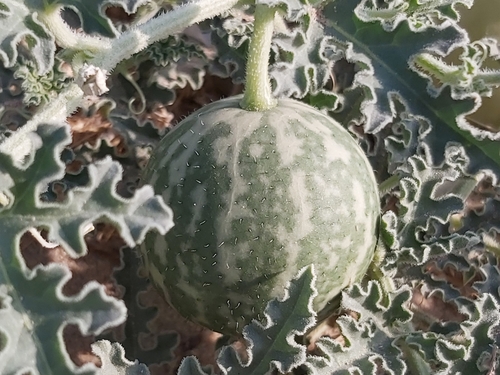
About Citrullus colocynthis (L.) Schrad.
Citrullus colocynthis (L.) Schrad. is a vining plant that reaches 2.4–3 meters (8–10 feet) in length. It is a desert-growing vine that thrives in sandy, arid soils. It is native to the Mediterranean Basin and Asia, with a distribution extending along the west coast of northern Africa, eastward through the Sahara and Egypt to India, and also reaching the north coasts of the Mediterranean and Caspian Seas. It also grows in Southern Europe and on the Aegean Islands. On the island of Cyprus, it is cultivated on a small scale; it has been an income source since the 14th century and is still exported today. In the arid zones of India, it can grow as either an annual or a perennial wild plant, and survives under extreme xeric conditions. It can tolerate annual precipitation of 250 to 1,500 mm (10 to 59 in) and an annual temperature range of 14.8 to 27.8 °C. It grows from sea level up to 1,500 m (4,900 ft) above sea level, in sandy loam, subdesert soils, and sandy sea coasts, within a pH range between 5.0 and 7.8. Historical trade accounts from 1895 document the harvest and trade of this species in Jaffa, Palestine, for export to England under the trade name Turkish colocynth. Based on an 1895 United States consular report that detailed colocynth growth in Palestine, the fruit grows abundantly between the mountains of Palestine and the eastern shore of the Mediterranean, from the city of Gaza northward to Mount Carmel. The plant grows completely without any care from farmers, as local climate and soil alone are sufficient for its full growth – its only natural requirements are sandy soil, a warm climate, and little moisture. The fruit, known commercially as Turkish colocynth, is collected by native fellaheen peasants in July and August, before it is fully ripe. It is then sold to Jaffa dealers, who peel it and dry the pulp in the sun. The dried pulp is shaped into small irregular balls, packed in boxes, and exported, mostly through England. As a perennial plant, C. colocynthis can propagate both by sexual (generative) and vegetative means. However, seed germination is poor due to extreme xeric conditions, so vegetative propagation is more common and more successful in natural settings. In the Indian arid zone, growth occurs between January and October, but the most favorable period for vegetative growth is summer, which coincides with the rainy season. Growth declines as soon as rains and temperatures drop, and almost stops during the cold, dry months of December and January. Colocynth prefers sandy soils, and is a good example of effective water adaptation that can be used in research to better understand how desert plants respond to water stress. Organic fertilizer may be applied to boost production. Colocynth is also commonly intercropped with cassava in Nigeria. Like any other crop, cultivated colocynth is affected by climatic stress and diseases, including cucumber mosaic virus, melon mosaic virus, and Fusarium wilt. A relatively new regeneration protocol has been developed to improve the crop, with the goal of introducing disease and stress resistance to increase yield potential and crop security while bypassing interspecific hybridization barriers. C. colocynthis can be eaten or processed as an energy source, for example as an oilseed and for biofuel. The characteristic small seeds of colocynth have been recovered from several early archeological sites in northern Africa and the Near East: specifically at Neolithic Armant and Nagada in Egypt; at sites dating from 3800 BC to Roman times in Libya; and in the pre-pottery Neolithic layers of the Nahal Hemar caves in Israel. Zohary and Hopf speculate that these finds indicate wild colocynth was very likely used by humans before it was domesticated. Colocynth has been widely used in traditional medicine for centuries. Colocynth powder was sometimes used externally alongside aloes, in ointments, or with bandages. Lozenges or pastilles made with colocynth were called "troches of alhandal" (trochisci alhandalæ) and used as a laxative. They were typically made from colocynth, bdellium, and gum tragacanth. The name alhandal derives from Arabic الْحَنْظَل (al-Ḥanẓal), the Arabic name for colocynth. In traditional Arab veterinary medicine, colocynth sap was used to treat skin eruptions in camels. In Palestine it has been used to treat constipation, scabies, and postpartum inflammation in sheep, cows, goats, and chickens. The oil obtained from the seeds makes up 47% of the seed content, and can be used to produce soap. Production is not time or energy intensive, because colocynth can grow on poor soils with only small amounts of moisture and organic fertilizer. Fruits are harvested unripe by hand, the rind is peeled away, and the inner seed-filled pulp is dried in the sun or in ovens. Seed yield ranges from about 6.7 to 10 tonnes per hectare (2.5 acres), meaning with an oil content of 31 to 47%, oil yields can reach up to 3 tonnes per hectare. Oleic and linoleic acids isolated from petroleum ether extracts of C. colocynthis show larvicidal activity against mosquitoes.