About Cirsium palustre (L.) Scop.
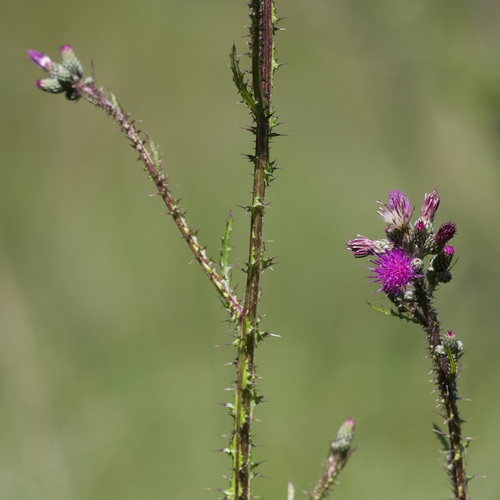
Cirsium palustre, the marsh thistle, is a tall thistle that can reach up to 2 metres (7 ft) in height. Its strong stems have few branches and are covered in small spines. In its first year of growth, the plant forms a dense rosette. The earliest leaves on this rosette are narrow, have smooth uncut edges, and bear spiny dark purple edges; later leaves of the rosette are larger and lobed. In following years, the plant produces a tall, straight stem that branches repeatedly near its tip, forming a candelabra-shaped cluster of dark purple flowers. Each flower measures 10–20 millimetres (0.4–0.8 in), and is subtended by bracts with purple tips. In the northern hemisphere, flowers bloom from June to September. Flowers are occasionally white; when they are white, the purple edges on the plant's leaves are absent. Ecologically, this species produces a large volume of nectar for pollinators. In a UK plants survey of top nectar-producing species, conducted by the AgriLand project supported by the UK Insect Pollinators Initiative, Cirsium palustre ranked first out of the top 10 for annual nectar production per unit cover. It is native to Europe, where it is especially common on damp ground including marshes, wet fields, moorland, and stream banks. In Canada and the northern United States, it is an introduced species that has become invasive. It grows in dense thickets that can outcompete and crowd out slower-growing native plants. Cirsium palustre has a broad distribution across most of Europe, extending eastward into central Asia. The presence of this species is tied to the spread of human agriculture that began in the mid-Holocene or earlier. It is a constant component of several fen-meadow plant associations, including the Juncus subnodulosus-Cirsium palustre fen-meadow. Its flowers are visited by a very wide range of insect species, giving it a generalised pollination syndrome.