About Cirsium lecontei Torr. & A.Gray
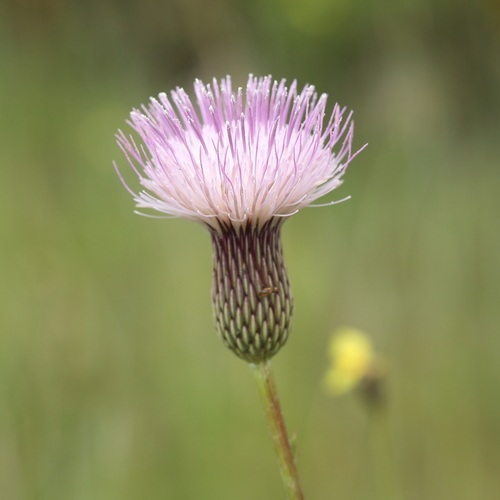
Cirsium lecontei, commonly called Le Conte's thistle, grows 35 to 110 cm tall, with a taproot that sometimes produces root sprouts. This spiny plant should be handled with care; its flowers are usually pink, and it requires full sun to grow. It has a Wetland Indicator Status of FACW (facultative wetland), meaning it usually occurs in wetlands but can grow in non-wetland areas too.
Stems are loosely covered in cobwebby arachnoid hairs, grow stiffly upward, and are often unbranched or only sparingly branched. Young leaves are also loosely arachnoid, but the plant loses these hairs with age to become glabrous (hairless and smooth). Mature leaf blades are linear to oblong or narrowly elliptic, with both abaxial and adaxial surfaces fully glabrous. Leaf blades have undivided lobes, or a small number of coarse teeth. Basal leaves are petiolate, and are sometimes absent when the plant is flowering. Mid-stem leaves are approximately 15 cm long; leaves gradually reduce in size moving up the stem, and are pinnately lobed.
Flower heads are borne singly, or in open corymbiform arrays of 2 to 5 or 10 heads. Peduncles holding the heads stand 5 to 30 cm above the stem leaves, so terminal flower heads sit above the plant's foliage. Corollas have feather-like pinkish to purple pappus bristles, which are modified sepals. Cypselae (dry fruits) are light brown and measure 5 to 5.75 mm long.
This species is distributed across the U.S. states of Alabama, Florida, Georgia, Louisiana, Mississippi, North Carolina, and South Carolina, where it grows on the southern coastal plain. It inhabits sandy pinelands with damp soil, where it co-occurs with Myrica, Cyrilla, and Ilex. It can also be found in moist to wet grassy pine savannahs, pine barrens, bogs, and roadside ditches. In bogs, associated species include pitcher plants, Ilex, sedges, grasses, and sphagnum.