About Cirsium horridulum Michx.
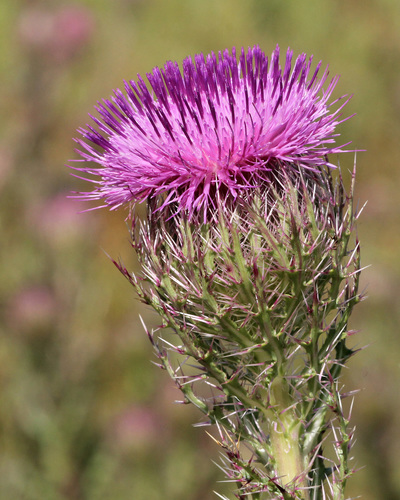
Cirsium horridulum Michx. is a biennial herb that reaches up to 250 centimeters (100 inches) in height. It grows with a large taproot and fleshy side roots, which sometimes sprout new shoots. Its leaves can grow up to 40 centimeters (16 inches) long, and have thick, sharp spines along their edges. Plants usually produce several flower heads, which are also covered in sharp spines. Each flower head contains only disc florets, with no ray florets. Flower color varies between individual plants, and can be white, yellow, pink, red, or purple. Three recognized varieties of this species have distinct ranges: Cirsium horridulum var. horridulum occurs from Maine to Guatemala; Cirsium horridulum var. megacanthum (Nutt.) D.J.Keil occurs from the Florida Panhandle to Texas and Oklahoma; and Cirsium horridulum var. vittatum (Small) R.W.Long occurs from North Carolina to Louisiana. In ecological terms, C. horridulum is a facultative upland species, meaning it can grow in wetlands but is most commonly found in non-wetland ecosystems. Its seeds are a type called cypsela, and are dispersed by both birds and wind. It acts as a larval host plant for two butterfly species: the little metalmark and the painted lady. Butterflies and bumblebees frequently visit its flowers to feed on the abundant nectar and pollen they produce. The leaf epidermis of this plant is surrounded by both an inner and outer cuticle, a trait that helps reduce the chance of pathogens entering the plant tissue.