About Cirsium fontinale (Greene) Jeps.
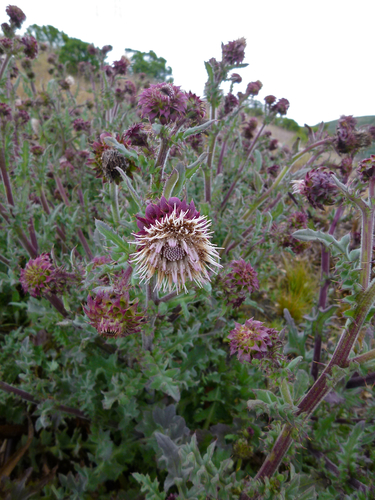
All taxa within the species Cirsium fontinale have erect stems with leaves that have very strongly wavy margins. These tall plants can reach a maximum height of 2.2 metres (7.2 ft), but can also grow as short as 0.5 metres (1.6 ft). An individual plant can produce one or more stems. Although the species is classified as perennial, plants are sometimes short-lived, dying after flowering just once. Lower leaves are typically petioled or tapered, and are mostly spiny-lobed; their petioles are either spiny-lobed or toothed. Inflorescences consist of prickly flower heads that are grouped more or less into panicle-like clusters, and are closely subtended by upper leaves. The involucres are either hemispheric or bell-shaped, and range in color from purple to green. Phyllaries have shapes between lanceolate and ovate. Each inflorescence typically holds many flowers, with white, pink, or lavender corollas that measure about 20 millimeters long. Anther bases are sharply sagittate, with oblong tips; the ends of the styles have a somewhat swollen node and a cylindrical superior appendage. The smooth, brownish fruits are distinctly ovoid, and measure four to five millimeters across; they bear many pappus bristles. Cirsium fontinale is endemic to restricted areas of northern and central California, growing at elevations no higher than 750 metres (2,460 ft). It is found only on serpentine seeps and streams in the California Coast Ranges, within the San Francisco Bay Area and San Luis Obispo County. Three varieties of Cirsium fontinale are currently recognized: Cirsium fontinale var. campylon, commonly called Mount Hamilton thistle, is found in the Diablo Range and southern Santa Clara Valley in the San Francisco Bay Area, and is a federal candidate for listing. Cirsium fontinale var. fontinale, commonly called Fountain thistle, is found in San Mateo County, and is listed as endangered by the U.S. federal government and the State of California. Cirsium fontinale var. obispoense, commonly called Chorro Creek bog thistle, is found in San Luis Obispo County, and is listed as endangered by the U.S. federal government and the State of California.