About Cirsium discolor (Muhl. ex Willd.) Spreng.
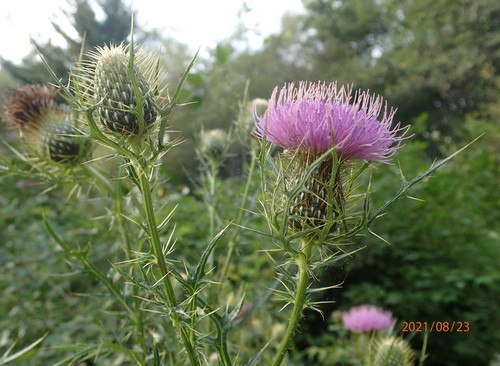
Cirsium discolor, commonly known as field thistle, is a North American plant species belonging to tribe Cardueae of the family Asteraceae. It is native to 33 U.S. states and four Canadian provinces, widespread across most of eastern and central Canada and eastern and central United States. Its range extends from New Brunswick west to Saskatchewan, and south to Texas and Georgia. Field thistle is a biennial or perennial herb that can grow up to 200 cm (78.5 in) tall, and produces a large taproot. It usually has only one stem, with numerous spiny leaves that are green on the upper surface and white and woolly on the underside. The plant's large, showy flower heads are pale to medium purplish magenta, with shades including lilac, lavender, pinkish purple, and purplish pink. This color is particularly attractive to butterflies, and the same flower color can be found in species of the genus Liatris and many other plant genera. Each flower head holds many disc florets and no ray florets. This species grows primarily in damp locations including forest openings, prairies, and disturbed sites. It is included as a component in some North American native-species-focused prairie and wildflower meadow restoration seed mixes. Like most other thistles, it serves as a food plant for Painted Lady butterfly caterpillars. Most thistles produce large amounts of nectar and pollen. Their large flower heads attract large butterflies such as migrating monarchs, and bumblebees visit thistles to gather pollen. Hummingbirds sometimes also collect nectar from thistle flowers. Cirsium discolor is similar in size, height, and general appearance to Bull Thistle, but it is less spiny, has whitish leaf undersides, and often has paler flowers than Bull Thistle. Many thistle species, including this one, are monocarpic, meaning they flower once then die. This species' reproduction relies on seed distribution, which is affected by interactions with insects, habitat characteristics, and weather conditions. When mashed, field thistle flower heads are reported to release a substance that acts similarly to rennin, which can curdle milk to help in cheese production.