About Cirrochroa thais Fabricius, 1787
This description covers the wet-season and dry-season forms of Cirrochroa thais, with separate details for males and females, and a recorded wingspan range of 60–75 mm.
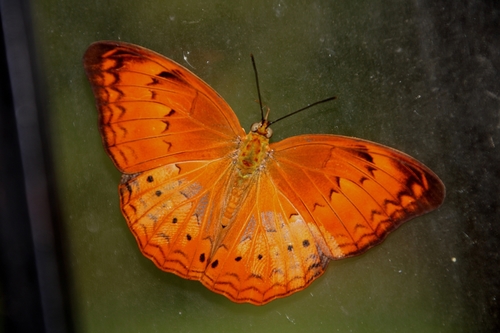
Wet-season form, male: Upperside is a rich bright fulvous color, darker towards the base. The forewing has a slender dusky discocellular streak, and a more or less prominent transverse discal black sinuous interrupted line; the anterior portions of this line, from the upper median, are dilated and bent inward. It also has two submarginal sinuous lines: the inner line broadens inward to the costa, while the outer line is partly merged into the black of the outer border. The hindwing is crossed by a more or less prominent, slender, broken black inner-discal line. Anteriorly, this line is bordered by an outer costal quadrate white patch, followed by a medial row of black spots, two submarginal sinuous lines, and an even marginal line. On the underside, the ground color comes in various shades of reddish-ochreous washed with pale violaceous-grey. There is a dusky brown subbasal line, and a transverse discal band that is white or violaceous-grey, dilated anteriorly. The inner edge of this band is brown-lined and more or less deeply sinuous or broken into dentate portions, while its outer edge is straight and unlined. After this band, the forewing has an outer-discal series of very obscure dusky dentate marks, the hindwing has a row of small black spots, and submarginal lunular lines matching the ground color are bordered by violaceous-grey.
Wet-season form, female: The apex of the forewing is more falcate. Upperside is paler than the male, but darker basally, with similar markings. Underside is olivescent greyish-ochreous or pale brownish-ochreous, washed with violaceous-grey, with markings similar to the male. The discal band is generally prominently edged on both sides by a dark purple-grey line, and the discal row of black spots on the hindwing is very small.
Dry-season form, male: Upperside is slightly paler than the wet-season male form, and all markings are comparatively less prominent. Underside is paler and a duller reddish-ochreous, with subbasal and outer markings that are obscure. The discal band on both wings is entire along its course, and matches the ground color or is white. Its inner edge is only very slightly sinuous, and is not broken into dentate portions as in the wet-season form.
Dry-season form, female: Upperside is also slightly paler than the wet-season female form, with less prominent markings. Underside is paler greyish-ochreous than the wet-season female form, with similar subbasal and outer markings. The discal band is entire, as in the dry-season male form, and is white.