About Cirripectes vanderbilti (Fowler, 1938)
This species, Cirripectes vanderbilti, reaches a maximum standard length of 10 cm (3.9 in).
Adult Body Color
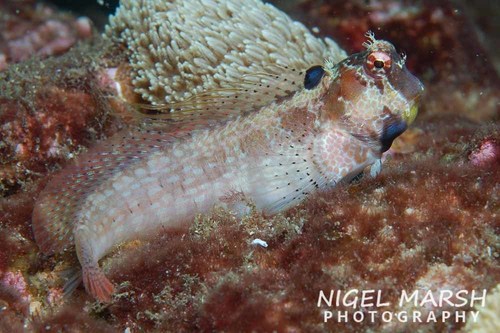
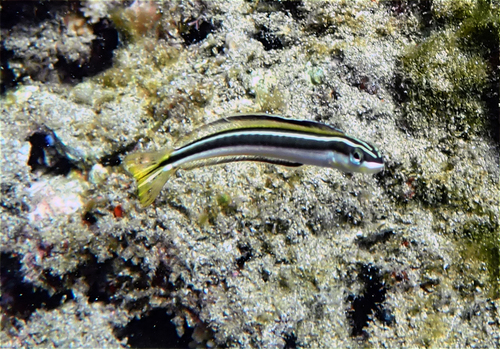
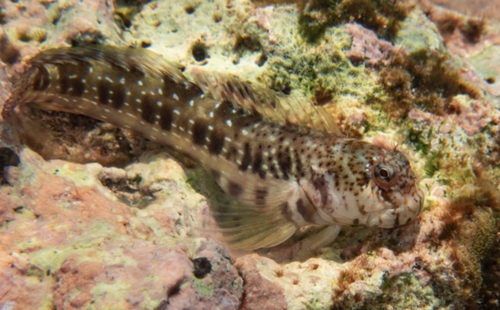
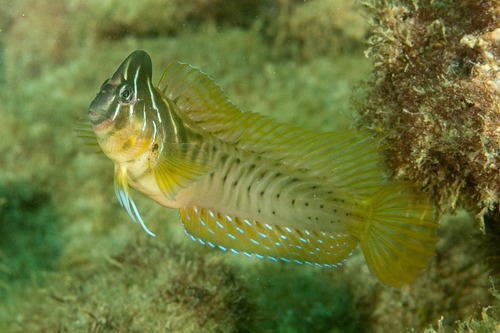
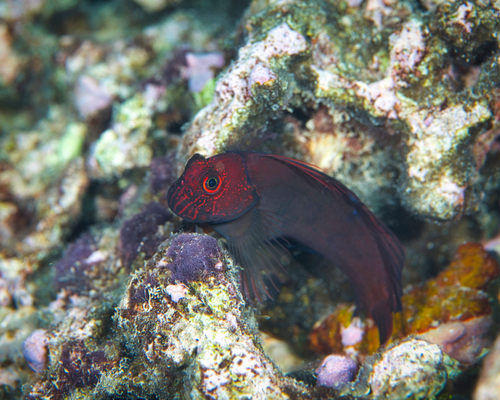
Adult individuals typically have a dark brown body, though rare individuals may be pale brown to white. The species' overall color pattern is highly variable.
Head Markings
It has dark red to orange slashes on its head that extend toward the back and top from the snout, and encircle the eye.
Fin Coloration
Its dorsal fin has yellowish-brown rays; the upper caudal-fin rays are yellowish, while the lower caudal-fin rays are dark brown.
Spine and Ray Identification Challenges
Among Hawaiian blennies, including this species, spines and soft rays are sometimes difficult to distinguish from one another. They can often be differentiated by holding the fin up against a strong light, or by removing the fin membrane from one side of the fin.
Spine Morphology
Generally, the spines of these blennies are soft and flexible, and more slender than articulated soft rays.
Original Species Description
Henry W. Fowler first formally described this species in 1938, under the original name Ophioblennius vanderbilti. The description was based on a specimen collected near Diamond Head, Oahu in 1937 by the George Vanderbilt South Pacific Expedition.
Species Distribution
This species is distributed in the Eastern Central Pacific, where it occurs around the Hawaiian and Johnston islands.
Habitat
It inhabits shallow rocky shores and reefs.