About Circus pygargus (Linnaeus, 1758)
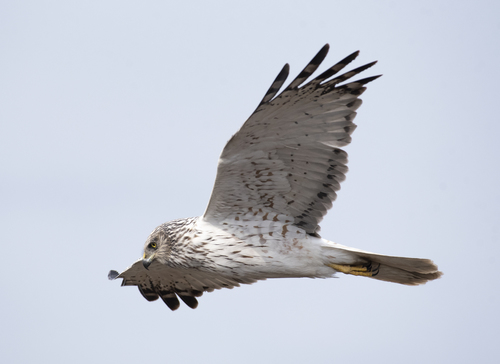
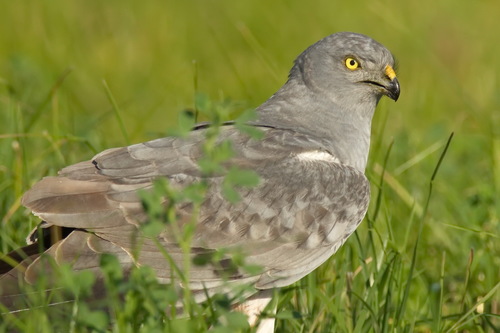
Montagu's harrier (Circus pygargus) is a harrier species, a bird of prey in the Accipitridae family. Its common name honors British naturalist George Montagu. The species is migratory; it breeds across large open areas of the Palearctic, and winters in Africa, the Indian subcontinent, and parts of the Arabian Peninsula.
Montagu's harrier occurs across a mid-latitude band that includes predominantly temperate climates, as well as Mediterranean and boreal zones. Though it has been recorded nesting at elevations up to 1,500 m (4,900 ft), it is primarily a lowland species. It nests mostly in broad river valleys, plains, and flat lands bordering lakes and the sea. It can breed in wetlands, though these wetlands are typically smaller and drier than those used by marsh harriers. It also uses heaths, dunes, moors, and steppe landscapes. It adapts to shrublands dominated by gorse or heather, and to areas planted with young conifers.
When no other suitable habitat is available, Montagu's harrier will nest in agricultural farmland, where it is vulnerable to harm from early harvesting. In agricultural areas it especially favors grasslands and cereal crops including wheat, barley, oats, and colza. In western Europe, up to 70% of the Montagu's harrier population breeds in artificial habitats. In summary, this harrier needs large open areas for breeding, with ground vegetation tall enough to provide cover but not overgrown. It prefers elevated perches such as fenceposts, small trees, or rocky outcrops where both males and females can rest and survey their breeding range. In all seasons, it hunts in areas of low or sparse vegetation, where prey is easier to spot. It generally avoids densely populated areas and is highly sensitive to disturbance.
Montagu's harrier remains widespread across most of the Western Palearctic. Most European countries hold at least a small population, with the exception of Norway, where the species does not occur. Its breeding range extends east to the Urals, and its westernmost breeding population is in Portugal. Breeding also occurs in northern Africa, mostly in Morocco. In Great Britain, the species is restricted to southern England. In Ireland, the species is rarely seen, mostly in the south, though there are a number of breeding records, the most recent of which dates to 1971.
Despite its broad distribution, Montagu's harrier is not common across much of its range. Only France, Spain, Russia, Belarus, and Poland hold strong populations, and host the majority of the European population. Breeding sites shift frequently, and some sporadic nesting occurs outside of known breeding areas. Even so, clear signs of a reduced breeding range are visible, linked to overall population decline.
The diet of Montagu's harrier consists mainly of small rodents, small birds, bird eggs, reptiles (including snakes), and large insects (most commonly Orthoptera, which make up the largest portion of the diet numerically). Because the species has such a wide distribution, it takes whatever prey is available in its nesting area: in the northern part of its range, it primarily hunts ground squirrels and rabbits, while in southern Europe it mostly eats small reptiles and large insects. In areas where the food supply is almost entirely made up of rodents, breeding success depends heavily on the cyclic population fluctuations of voles. Montagu's harriers will sometimes regurgitate pellets.
Like other harriers, Montagu's harrier catches prey while flying along fixed routes at low heights and a steady slow speed of around 30 km/h (19 mph). Its flight is lighter and more dexterous than that of other harrier species, allowing it to catch more agile prey. When possible, it often follows the edges of different vegetation patches to ambush prey by surprise. It captures prey after a short diving stoop, though it will chase fast-running animals and flying birds over short distances.
During the breeding season, the male provisions food to the female and later to the pair's young. The provisioning rate increases from 5 to 6 trips per day during incubation to 7 to 10 trips per day after the young hatch, though wet, foggy, or windy weather can hinder the male's ability to hunt. Following the typical harrier behavior, prey is passed between the breeding pair mid-air: the female flies below the male, who drops the prey for her to catch. The male hunts over a large territory that extends up to 12 km (7.5 mi) away from the nest. The female hunts closer to the nest, within 1 km (0.62 mi), and only begins hunting after the young have hatched.