About Circus maurus (Temminck, 1828)
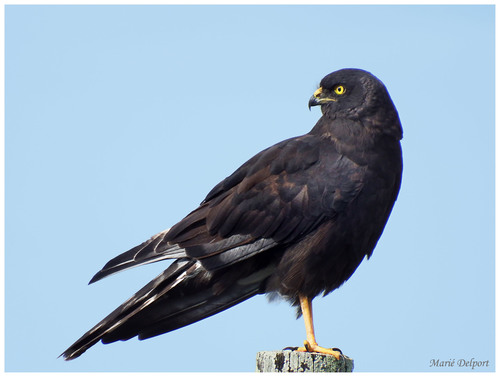
The black harrier, scientifically named Circus maurus, is a medium-sized African harrier that ranges from South Africa to Botswana and Namibia. It has a body length of 44–50 cm (17–20 in) and a wingspan of 105–115 cm (41–45 in). When perched, this bird appears entirely black. In flight, however, a white rump and white flight feathers become visible. It shares a similar body structure with other harriers: it has narrow wings, a slim body, and a long tail. Adult males and females have similar plumage, while juvenile black harriers have buff underparts and heavily spotted breasts. In South Africa, the black harrier’s distribution is distinctly split between the Western and Southern coastal plains. Nests are concentrated either along the coastal strip or inland in montane habitat, and nests are generally absent from transformed and cultivated lands. Even though black harriers do not breed in these transformed and cultivated areas, there is some evidence from sightings and prey remains that they do forage there. Black harriers are migratory birds, and their annual movements cover the southern half of South Africa, including Lesotho, though there is great individual variation in migration patterns. Most black harriers undertake an unusual west-to-east migration. They leave their breeding grounds in south-western South Africa and migrate to the Eastern Cape, south-western Kwa-Zulu Natal, south-western Mpumalanga, and north-eastern Lesotho during the summer months. Breeding pair members do not travel together, and they do not share the same non-breeding areas. It has been suggested that black harriers migrate to cope with food scarcity. Unusually, black harriers travel almost twice as fast during their summer post-breeding migration than during their winter or spring pre-breeding migration — the opposite pattern commonly reported for many other bird species. One explanation for this difference is that the extra time taken during pre-breeding migration allows black harriers to search for the best possible breeding areas. The size of black harriers’ home ranges is similar during breeding and non-breeding seasons, which indicates that food availability is at similar levels in both seasons. Black harriers show some fidelity to breeding areas, returning to breeding sites they have used before, as well as natal philopatry, returning to their birthplace to breed. Large breeding dispersal events can still occur, however. In recent years, the black harrier population has declined to fewer than 1000 birds, and the species is now considered endangered in South Africa, Lesotho, and Namibia. The population decline is caused by the destruction of the species’ original breeding habitat: South Africa’s natural fynbos shrubland. This habitat has been greatly reduced by expanding cereal cultivation, urban expansion, and invasion by alien plant species. As a result, black harriers have been displaced from their lowland Renosterveld and Fynbos habitats into montane habitat, which does not offer the same foraging and nesting opportunities that Renosterveld and Fynbos provide. Black harriers living in montane environments are less successful than those in coastal fynbos areas: they have lower breeding success, hunt a wider range of prey, and experience higher rates of nest predation. Breeding at coastal sites is more successful than breeding at montane sites: coastal black harriers start breeding earlier, hatch larger broods, fledge more young, and face lower levels of nest predation. Overall, this land transformation has negatively affected black harrier populations.