About Circus cyaneus (Linnaeus, 1766)
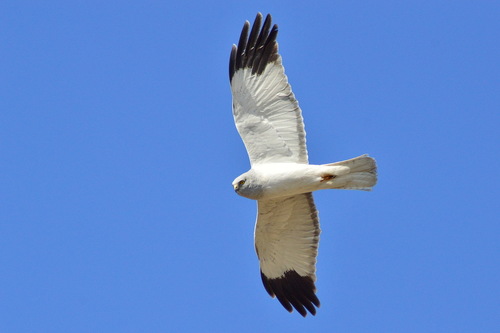
The hen harrier (Circus cyaneus) measures 41–52 cm (16–20 in) in body length, with a wingspan ranging from 97–122 cm (38–48 in). Like other harrier species, it has distinct plumages that differ between males and females. Males and females also differ in body weight: males weigh 290 to 400 g (10 to 14 oz), averaging 350 g (12 oz), while females weigh 390 to 750 g (14 to 26 oz), averaging 530 g (19 oz). For standard measurements, the wing chord is 32.8 to 40.6 cm (12.9 to 16.0 in), the tail is 19.3 to 25.8 cm (7.6 to 10.2 in), and the tarsus is 7.1 to 8.9 cm (2.8 to 3.5 in). This bird has relatively long wings and a relatively long tail. Males are mainly grey on the upper body and white on the lower body, except the upper breast, which matches the grey color of the upperparts, and the rump, which is white; the wings are grey with black wingtips. Females are brown on the upper body with white upper tail coverts, which is why females and similar-looking juvenile hen harriers are often called "ringtails". Females' underparts are buff with brown barring. Juveniles resemble females, but have less distinct barring, dark brown secondaries, and a less-barred belly. When receiving food from a male, the female makes a whistled piih-eh call, and her alarm call is chit-it-it-it-it-et-it. The male makes a chek-chek-chek call, and uses a more bouncing chuk-uk-uk-uk call during his display flight.