About Circus buffoni (Gmelin, 1788)
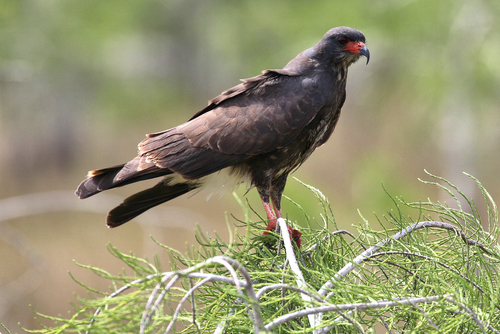
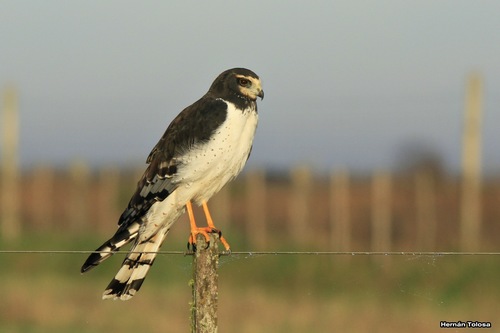
The long-winged harrier, Circus buffoni (Gmelin, 1788), is a mid-sized bird of prey. Like most birds of prey, females are larger than males: males weigh 390 to 464 g (13.8 to 16.4 oz), while females weigh 400 to 645 g (14.1 to 22.8 oz). The species ranges 46 to 60 cm (18 to 23.5 in) in length, with a wingspan of 120 to 155 cm (47 to 61 in). As with other harrier species, it can be identified by its long narrow tail and especially long wings. Its wings and back are mostly grey, with much darker primary wing feathers; the remaining wing feathers are streaked with white, grey, and brown. The long-winged harrier has two distinct morphs: dark morph and light morph. Dark morph individuals have an all-black belly, with females showing more of a brown undertone. Light morph individuals have white underparts, which contrasts strongly with the dark morph. Juvenile long-winged harriers usually have the same colour patterns as adult females, but they have a more speckled chest. Morphologically, the long-winged harrier resembles its close relative, the South American cinereous harrier (Circus cinereus), but their ranges rarely overlap. Like all other birds of prey, the long-winged harrier has sharp talons for catching prey on the ground or in the air, and it has bright orange legs. It also has the large hooked beak typical of birds of prey, which it uses to tear apart caught prey meat. Long-winged harriers belong to the only group of diurnal birds of prey that possess a facial disc: a distinct disc-shaped arrangement of feathers around the face. These feathers can be raised in response to sound, and they improve the bird's hearing while hunting by helping to triangulate sounds into its ear openings. Little is known about the long-winged harrier's vocalizations, as it is not a very vocal bird. It mostly calls when in flight; known calls include a fast succession of "klee-klee-klee", and a quieter "thrill" call with a quickly descending pitch. The long-winged harrier's year-round range covers most of eastern South America, including eastern Argentina, Uruguay, Brazil and Paraguay, and extends north to Colombia, Venezuela, and the northern tips of Guyana, Suriname and French Guiana. It has also been observed occasionally in extra areas including Bolivia, Peru, Chile, Trinidad and Tobago, and as far south as Tierra del Fuego in southern Argentina. It is a vagrant species to Panama and the Falkland Islands. This species lives in large grasslands and agricultural fields, where its wide-ranging active hunting technique is very effective. Its habitat also includes South American savannas, marshes and wetlands. Like all members of the family Accipitridae, the long-winged harrier is carnivorous, and feeds on a wide variety of animals across its large range. Its diet includes small mammals (such as cavies), amphibians (such as frogs), reptiles (such as lizards) and birds (such as crakes and young coots); birds make up the majority of its food intake. It also feeds on bird eggs, ranging from taking full ball-nests of water-tyrants to raiding heronries. Its hunting strategy differs greatly from other hawks that share its habitat, such as the roadside hawk (Rupornis magnirostris). Instead of using a passive hunting strategy that relies on high perches to locate prey, the long-winged harrier flies slowly in large circles over its range to find prey, using its keen vision and hearing.