About Circus approximans Peale, 1848
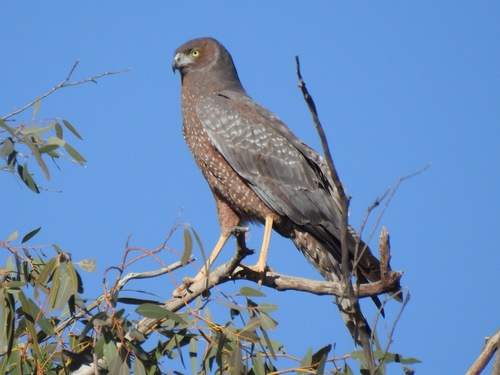
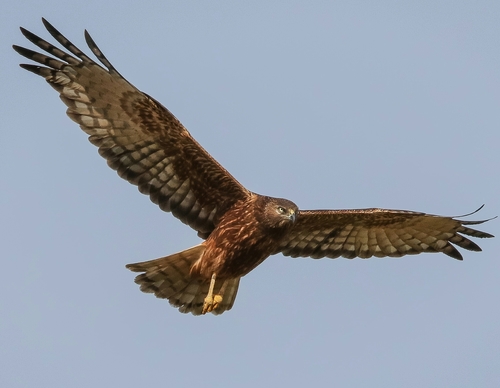
The swamp harrier (scientific name Circus approximans Peale, 1848) is largely dark brown, with plumage that lightens as the bird ages, and has a distinct white rump. It hunts by flying slowly, low to the ground, with upswept wings. Its body length ranges from 48 to 62 cm (19 to 24.5 in), and its wingspan ranges from 118 to 145 cm (3 ft 10 in to 4 ft 9 in). Recorded adult weights range from 580 to 1,100 g (1.28 to 2.43 lb), and females are significantly larger than males. In New Zealand, 54 studied males had an average weight of 640 g (1.41 lb), and 66 studied females had an average weight of 870 g (1.92 lb). Based on average weights and linear measurements, the swamp harrier may be the largest extant harrier species by a slight margin. It is only marginally larger than some other harrier species, such as marsh harriers and the Réunion harrier.
The swamp harrier is widespread across Australasia and many islands in the south-west Pacific region. This includes most of Australia, with the exception of arid regions, New Zealand where it is common in open country, Fiji, Vanuatu, and New Caledonia; it also occurs as a straggler on some subantarctic islands. It typically inhabits wetlands and well-watered open country. According to available evidence, the swamp harrier most likely only became established in New Zealand within the last 800 years, after the first Polynesian settlers extensively cleared lowland forests. It is absent from New Zealand's older fossil record. Archaeological and genetic research indicates humans arrived in New Zealand no earlier than around 1280, with the main settlement period occurring between approximately 1320 and 1350, which aligns with evidence from genealogical traditions. The larger, endemic New Zealand harrier species Eyles's harrier (Circus teauteensis) became extinct after human settlement. All studied New Zealand swamp harrier remains are at most around 1000 years old, meaning they date to after human settlement. There is no evidence that swamp harriers and Eyles's harriers coexisted widely in New Zealand. Despite considerable differences between the two species, they were still ecologically similar enough to competitively exclude one another. Apparently, the swamp harrier was only able to become established after the endemic Eyles's harrier went extinct. The swamp harrier has benefited from European settlement, and is now very common, especially in open farmland.