About Circaetus gallicus (Gmelin, 1788)
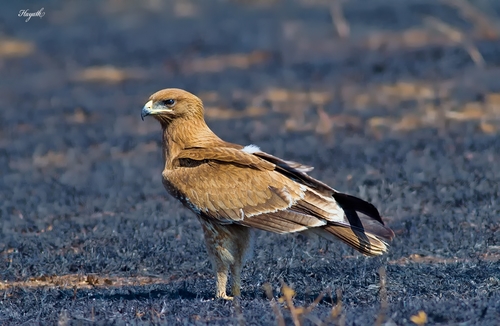
This species, known as the short-toed snake eagle, is a relatively large type of snake eagle. Adult individuals reach 59 to 70 cm (23 to 28 inches) in length, have a wingspan of 162 to 195 cm (5 feet 4 inches to 6 feet 5 inches), and weigh between 1.2 and 2.3 kg (2.6 to 5.1 lb); the average weight for the species is approximately 1.7 kg (3.7 lb). It can be identified in the wild by its mostly white underside and greyish-brown upper parts. The chin, throat, and upper breast are pale, earthy brown. The tail has 3 or 4 dark bars. Other identifying features include an owl-like rounded head, bright yellow eyes, and lightly barred underwings.
The short-toed snake eagle spends more time flying than most other members of its genus. It prefers to soar over hill slopes and hilltops using updrafts, and does most of its hunting from this position at heights of up to 500 m (1,600 ft). When moving across open country, it frequently hovers similarly to a kestrel. When it soars, it holds its wings in a flattish position.
This is an Old World species that occurs throughout the Mediterranean basin, extending into Russia, the Middle East, parts of Western Asia, the Indian subcontinent, and further east on some Indonesian islands. Populations on the northern edge of the Mediterranean and in other parts of Europe are migratory, and mainly travel to sub-Saharan Africa north of the equator. They leave their breeding grounds in September or October and return in April or May. Populations in the Middle and Far East are non-migratory, or resident. In Europe, the species is most numerous in Spain, where it is fairly common, but it is rare across many other parts of its European range. A bird recorded on the Isles of Scilly, Britain, in October 1999 was the first confirmed sighting of the species in Britain. The short-toed snake eagle inhabits open cultivated plains, arid stony deciduous scrub areas, foothills, and semi-desert areas. It requires trees for nesting and open habitats such as cultivated land and grasslands for foraging.