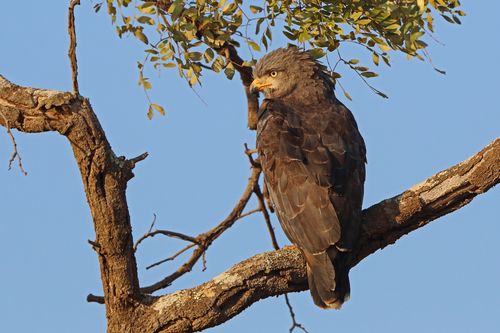
About Circaetus cinerascens J.W.Von Muller, 1851
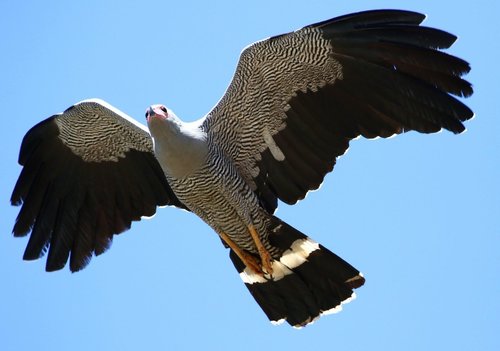
The western banded snake eagle, scientifically named Circaetus cinerascens J.W.Von Muller, 1851, is a grey-brown African raptor with a short tail and a large head. Juveniles have paler, browner upperparts than adults, with feathers edged in white. This species' head, neck, and breast are marked with dark streaks. Its underparts are white with pale brown streaks, concentrated most on the belly and thighs. Subadults can be entirely dark grey-brown with no streaks on their underparts. The western banded snake eagle has yellow eyes, ears, and legs, and crests on its chest. This species lives in woodlands, mostly along rivers, and avoids dense forests. It is distributed across Africa, in the northern tropics from Senegal and Gambia eastward to Ethiopia, then south to southern Angola and Zimbabwe. Most of its range falls west of the Rift Valley, and it is mostly absent from western lowland equatorial forests. It occupies woodland and forest edge habitats. This is an uncommon, often hard to spot bird, with a patchy distribution, and it is vulnerable to loss of its riverine habitat. It feeds primarily on reptiles and amphibians, which it captures either on the ground or in trees. For reproduction, the western banded snake eagle builds a new nest every year, placed among creepers and foliage. It makes a small stick nest that is well hidden within surrounding vegetation. The female lays only one egg per clutch. Incubation lasts between 35 and 55 days, and is done mainly by the female. Young eagles fledge from the nest 10 to 15 weeks after hatching.