About Circaea lutetiana L.
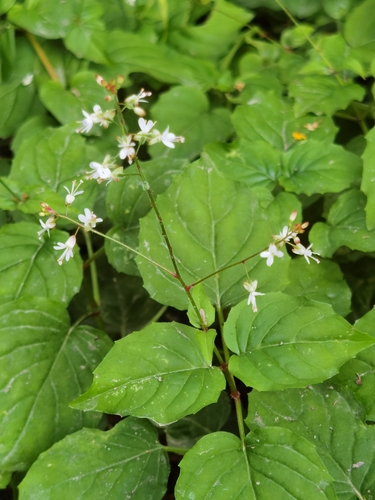
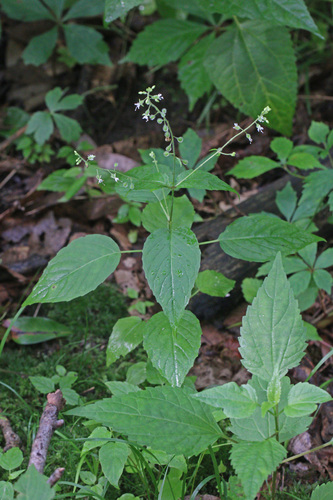
Circaea lutetiana L. is a perennial herbaceous plant. It has slender green stems that bear opposite, simple leaves. It reaches 20 cm to 60 cm in height, and rarely grows as tall as 75 cm. Its white flowers bloom in summer. The base of each leaf is rounded or slightly notched, the leaf narrows gradually to a pointed tip, and edges are not strongly toothed but sinuate. Leaf stalks are equally hairy all around. Each flower has 2 notched petals, 2 stamens and a 2-lobed stigma. Open flowers are well spaced along the stalk, and there are no bracts at the base of individual flower stalks. Before fruiting, flower stalks bend to angle downwards. The fruit has 2 equal cells and usually produces viable seed. It is a small bur measuring 3.5–5mm, a structure that helps the plant disperse its seeds via zoochory. In winter, all above-ground aerial parts of the plant die off, leaving an underground rhizome. This species can hybridize with Circaea alpina, producing sterile offspring that persists as vegetative colonies. This plant is native to Europe, Middle Asia, and Siberia. Populations that were previously placed in this species from North America are now classified as a separate species, Circaea canadensis. It grows in woods in deep shade and moist environments on nitrogen-containing clay.