About Ciona savignyi Herdman, 1882
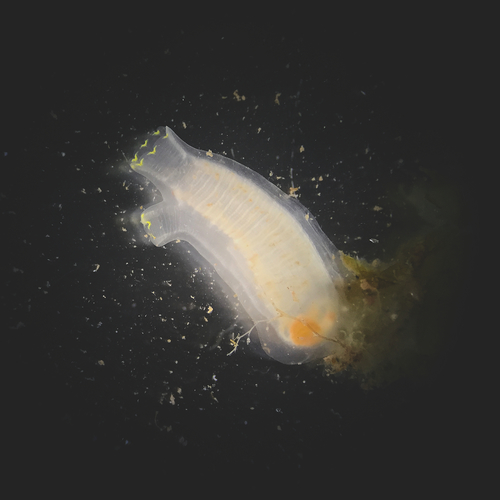
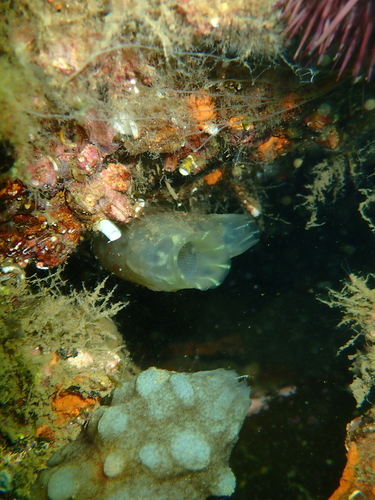
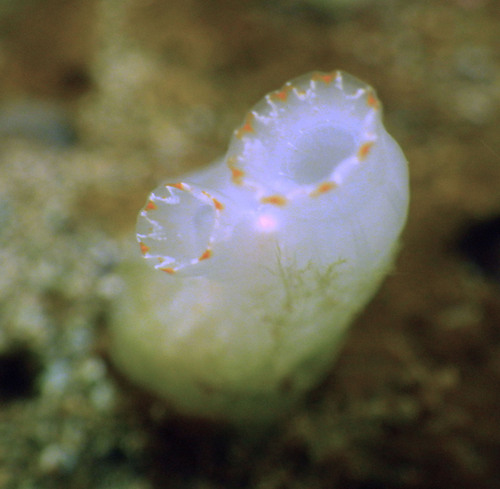
Ciona savignyi is a solitary, bottle- or vase-shaped tunicate that grows to a length of about 15 cm (6 in). It is usually broader near its base, and this broader section is permanently attached to a hard surface. Its outer covering, called the tunic, is soft, gelatinous, and translucent, and ranges in color from whitish to cream. Muscle bands and internal organs can often be seen through the tunic. At the narrower, free end of the tunicate, there is a buccal siphon that draws water into the animal. This opening is rimmed by eight yellow-edged lobes, each of which has an orange-red spot. On the side, not far from the buccal siphon, there is an atrial siphon through which water is pumped out of the body. The atrial siphon has six similar yellow lobes with red spots. Between five and seven longitudinal muscle bands run along the tunic, and the siphons can be retracted when the animal is threatened. This species is easily confused with the very similar Ciona intestinalis, but Ciona savignyi has white flecks in the tunic wall that C. intestinalis does not have. C. intestinalis also lacks the reddish color associated with the buccal siphon of Ciona savignyi. Ciona savignyi is native to Japan, and may also be native to Alaska and British Columbia. In 1985, it was recorded in Long Beach Harbor, California, and has since spread to a number of other locations in the state. By 1998, it had also been reported in Puget Sound and the San Juan Islands. It favors growing on docks, pilings, marinas, harbors, and aquaculture structures, and is thought to have spread via ship ballast water or on ship hulls. It is classified as an invasive species in the United States. The first record of this species in the southern hemisphere was from Nelson, New Zealand in April 2010. Since then, it has been found in port and harbor areas across New Zealand, and was detected in Hobart, Australia in 2017. While its environmental impact is still unclear, the species is able to form dense patches that inevitably compete with native species for planktonic food.