About Cinclodes taczanowskii Berlepsch & Stolzmann, 1892
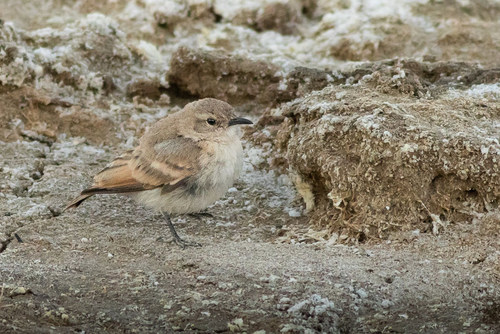
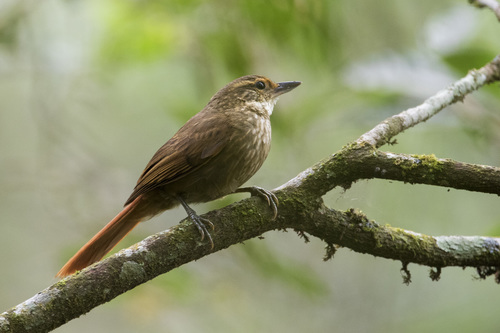
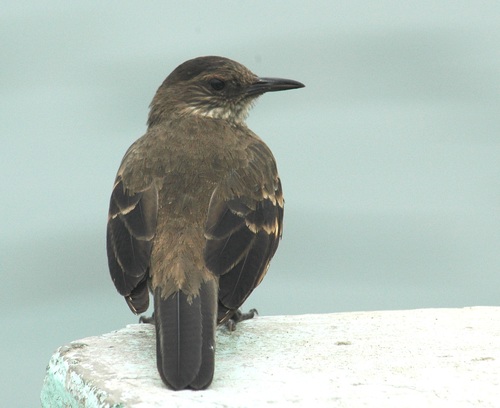
The Peruvian seaside cinclodes, scientific name Cinclodes taczanowskii Berlepsch & Stolzmann, 1892, is approximately 21 cm (8.3 in) long and weighs approximately 63 g (2.2 oz). It is a large member of the genus cinclodes with a straight bill. Both sexes have identical plumage. Adults have an indistinct buffy brown supercilium, with the rest of the face being brownish. The crown is dark sepia brown, and the upperparts are dark brown. Wing coverts are dusky brown with paler edges. Primaries are dusky brown, and most have cinnamon buff or pale rufous bases. Secondaries have rufous bases bordered with blackish coloring and dusky brown tips. Tertials are dusky brown with rufescent brown edges. The tail is blackish brown; the outer three pairs of feathers have progressively more pale rufous coloring on their tips. The throat is dirty white with dusky spots, the breast is brown with short pale streaks, and the belly is plain brown. The iris is brown, the bill is black or brown, and the legs and feet are dark gray-brown or black. The Peruvian seaside cinclodes is distributed along the Peruvian coast, ranging from the Department of Ancash south to the Department of Tacna near the Chilean border, and also lives on several nearshore islands. It inhabits the intertidal zone, where it favors rocky areas, though it will occasionally move into adjacent sandy areas.