About Cinclodes patagonicus (Gmelin, 1789)
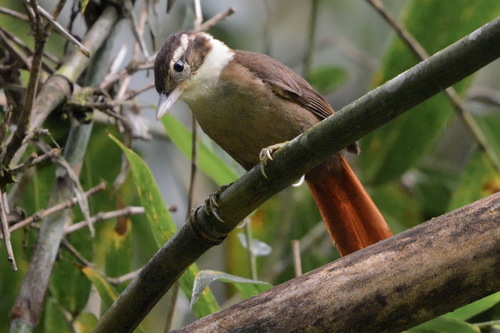
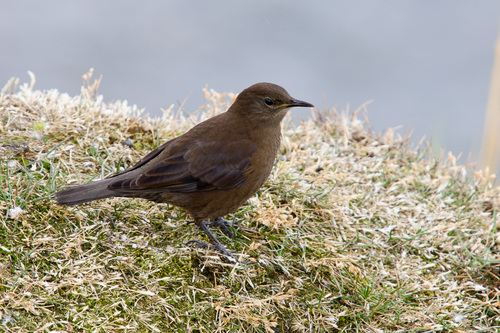
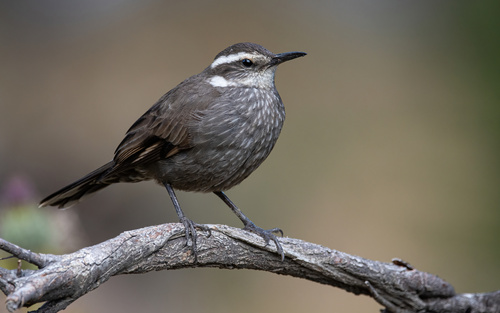
The dark-bellied cinclodes (scientific name Cinclodes patagonicus (Gmelin, 1789)) measures 18 to 20 cm (7.1 to 7.9 in) long and weighs approximately 36 to 50 g (1.3 to 1.8 oz). It is a relatively large cinclodes with a long decurved bill. The sexes share identical plumage, and the two recognized subspecies differ only very slightly. Adults of the nominate subspecies have a white supercilium starting at the forehead, dark brown lores and ear coverts, and a white malar area marked with a few faint darker flecks. Their crown and nape are dark brown, and their upperparts are a slightly lighter brown. Their wings are dark brown with blackish brown primary coverts; both the primary coverts and flight feathers have a thin pale band with a rufous tinge that appears white. Their tail is dark brown, and the outer three pairs of feathers have progressively more tawny-whitish coloring on their tips. Their throat is whitish with faint darker specks, and most of their underparts are dull dark brown. Their upper breast has pale spots that transition into streaks extending through the lower breast onto the upper belly. Their undertail coverts are dark brown with whitish tips. Their iris is dark brown, their bill ranges from brown to blackish, and their legs and feet range from brown to blackish. Juveniles resemble adults, but have pale edges on the feathers of their back and less distinct breast markings. Subspecies C. p. chilensis is slightly smaller than the nominate subspecies, with buffier tips on the outer tail feathers and slightly browner underparts with less streaking on the belly. This species is native to the southern cone of South America. The more northerly of the two subspecies is C. p. chilensis, which is found in south-central Chile between the Atacama and Aysén regions, as well as in adjacent western Argentina between Mendoza Province and Santa Cruz Province. The nominate subspecies ranges south to Tierra del Fuego from Aysén in Chile and Santa Cruz in Argentina. The dark-bellied cinclodes lives in a variety of landscapes, all of which are associated with water. Habitats include rocky coastal beaches, lakesides, river and stream banks, and the edges of wet forest. It stays near water even when in semi-arid areas. In the northern portion of its range it occurs mostly inland, while in the south it is found at sea level. In the Andes, it reaches elevations of approximately 3,500 m (11,500 ft).