About Cinclodes fuscus (Vieillot, 1818)
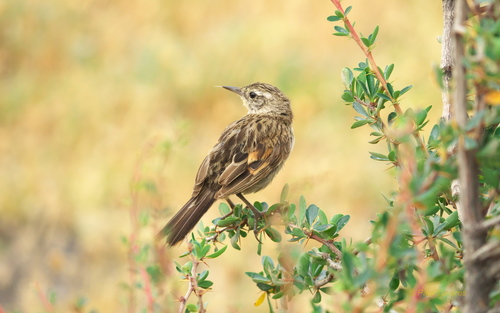
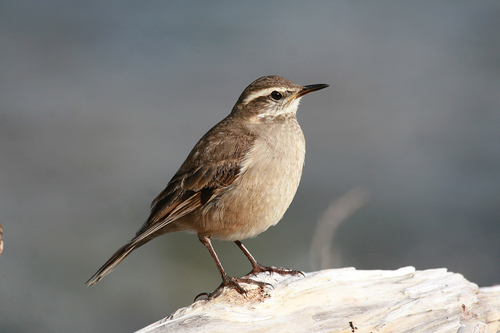
The buff-winged cinclodes (Cinclodes fuscus Vieillot, 1818) measures 15 to 19.4 cm (5.9 to 7.6 in) in length and weighs 29 to 33 g (1.0 to 1.2 oz). It is a small member of the genus Cinclodes with a moderately short bill. Males and females have identical plumage. Adults have a distinct light buffish white supercilium, dark gray-brown ear coverts marked with pale streaks, and a bright white malar area that flares toward the rear. Their forehead is speckled, their crown dark gray-brown, and their upperparts dark brown. Their wing coverts are dark brown with wide buffish edges, and their flight feathers are dark fuscous with a narrow tawny-rufous band across them. The central feathers of their tail are dark brown, and the rest are blackish brown; the outer three pairs have progressively larger pale tawny tips, and the outermost pair also has a tawny outer web. Their chin is white, their throat is white with thin dark scallops, their breast is dull pale brown with faint buff streaks, their belly is whitish buff, their flanks are dull brown, and their undertail coverts are mottled brown and buff. Their iris is brown or dark brown, their bill is dark brown to blackish with the mandible often having a paler base, and their legs and feet are blackish to dark brownish. Juveniles have richer coloration than adults, with dark edges on most of their underpart feathers. Buff-winged cinclodes is resident year-round in central and southern Chile and most of central and southern Argentina, including Tierra del Fuego. It migrates to northern Argentina, southern Brazil, southeastern Paraguay, and Uruguay, and has also been recorded as a vagrant on the Falkland Islands. It inhabits a wide range of open habitats, most of which are grassy, including páramo, puna, and temperate grasslands. It also occurs in arid montane scrublands, Patagonian steppes, beaches, and open Patagonian woodlands. It is usually found near water, particularly bogs and streams, and is commonly seen around human settlements. It occurs at elevations from sea level up to 3,000 m (9,800 ft).