About Cinclodes atacamensis (Philippi, 1857)
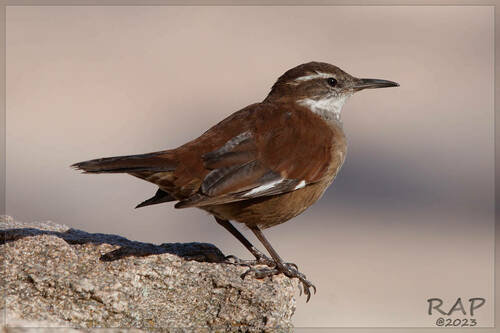
The white-winged cinclodes (Cinclodes atacamensis, first described by Philippi in 1857) measures 19 to 20 cm (7.5 to 7.9 in) in length and weighs 45 to 56 g (1.6 to 2.0 oz). It is a fairly large member of the cinclodes genus, with a decurved bill. The plumage of males and females is identical. Adults of the nominate subspecies have a whitish supercilium, brownish gray lores, grayish brown ear coverts with reddish tones, and a whitish malar area marked with faint darker flecks. Their crown is grayish brown, and their upperparts are a rich reddish brown. Their wing coverts are also reddish brown. The wings have white coloring at the bend, and blackish flight feathers with white across their base that forms a conspicuous band. The central tail feathers are dark fuscous brown with paler shafts; the remaining tail feathers are blackish brown, with increasingly large white spots moving from the innermost to the outermost feathers. Their throat is whitish with faint dark specks, their breast and sides are buffy grayish, their belly is brownish gray, their flanks are rich brown, and their undertail coverts are mottled brown and grayish white. Their upper breast has faint pale streaks and flecks that fade almost completely on the lower breast. Their iris is dark brown, their bill is blackish to dark horn, and their legs and feet are dusky brown. Juveniles resemble adults, but have pale edges on the feathers of their lower back and less distinct breast markings. Subspecies C. a. schocolatinus has darker brown upperparts and grayer underparts than the nominate subspecies, with dark brown sides and flanks. The nominate subspecies of white-winged cinclodes ranges from the Department of Ancash in central Peru south through western Bolivia to Chile's Santiago Metropolitan Region and Mendoza Province in northwest Argentina. Subspecies C. a. schocolatinus is found in the provinces of Córdoba and San Luis in west-central Argentina. This species inhabits puna grasslands and slopes with rocks or shrubs. It almost always occurs along flowing streams and rivers. Most of its population lives at elevations between 2,800 and 4,500 m (9,200 and 14,800 ft), though it can be found locally as low as 2,200 m (7,200 ft).