About Cinclodes antarcticus (Garnot, 1826)
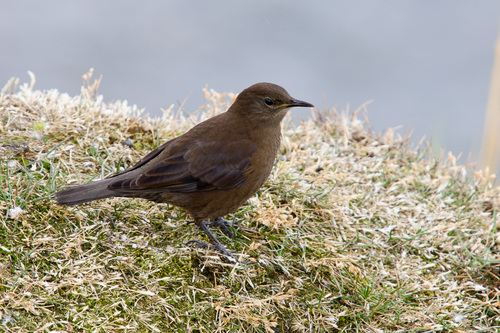
Blackish cinclodes, with the scientific name Cinclodes antarcticus (Garnot, 1826), measures 18 to 23 cm (7.1 to 9.1 in) long and weighs approximately 63 g (2.2 oz). Males and females have identical plumage. Adult nominate subspecies individuals are mostly dark sooty brown, with a slightly paler throat and some dull rufous coloring at the base of the flight feathers. This rufous marking is usually only visible when the bird is in flight. The species has a dark brown iris, blackish bill, and blackish legs and feet. Juvenile blackish cinclodes are generally browner than adults. The subspecies C. a. maculirostris is slightly larger than the nominate subspecies, with a shorter bill and longer tail. It is blacker overall, has a visibly yellowish base to its bill, and has no rufous coloring on its wings. The nominate subspecies occurs on the Falkland Islands; surveys completed by the late 1990s found this subspecies on 40 out of the 59 islands included in the study. Subspecies C. a. maculirostris occurs in the southernmost part of mainland Chile, on both Chilean and Argentine portions of Tierra del Fuego, and on other islands in the Cape Horn Archipelago. Blackish cinclodes is primarily a coastal species, though it can range as far inland as 0.5 km (0.3 mi). It favors landscapes with short grass and tussock grass (Poa flabellata), and is also common around human habitations. Both subspecies are often found on rocky beaches near colonies of marine mammals and seabirds. Their elevation range extends from sea level to about 200 m (700 ft).