About Cigaritis lohita
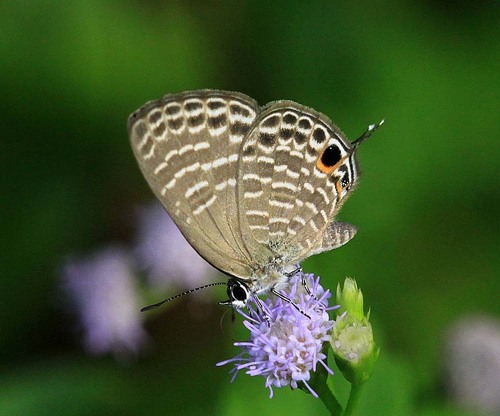
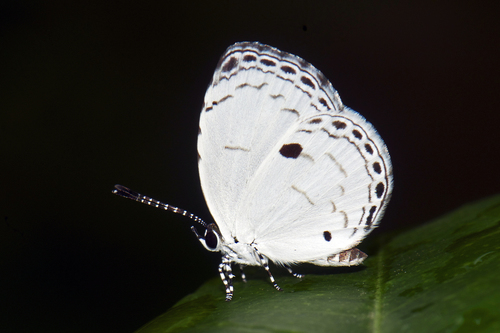
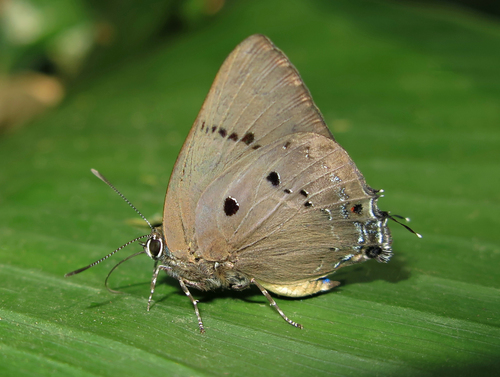
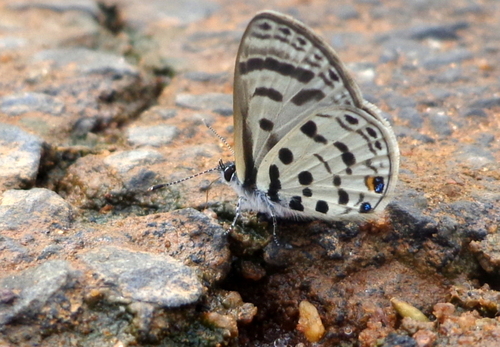
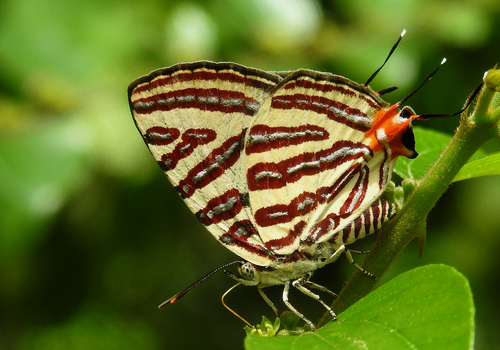
This section describes the butterfly Cigaritis lohita, starting with the male. On the upperside, male wings are blackish-brown, tinted with violet-blue. The violet-blue on the forewing has a gloss in certain lighting and blends into the black costal and outer marginal borders; sometimes, the bands from the underside are visible through the forewing. On the hindwing, the blue color is more distinct and somewhat glossier, covering nearly the entire wing surface except the broadly pale blackish-brown costal space and abdominal fold. The hindwing has a black outer marginal line, a fairly large anal orange patch, a black spot in the anal lobe, and a smaller black spot between the tails. Both black spots have some silvery scales; the tails are black and tipped with white. The cilia of both wings are grey. On the underside, the ground color is yellowish-white, with very dark red bands that hold more or less disconnected silvery lines inside them. On the forewing, a sub-basal bar from the costa connects to a short streak from the base, and another bar runs from the costa across the middle of the cell; both have suffused blackish areas below them. An outwardly oblique bar extends from the costa across the end of the cell to the sub-median vein, with a small, narrow, inwardly bent short blackish bar as a continuation. Two short bars from the costa meet toward the hind part of the wing. There is an even sub-marginal band that ends close to the end of the oblique band in the same pattern, plus an even marginal band. These two bands are so close together that only a thin line of the yellowish-white ground color remains between them. A black marginal line runs along the edge, with a fine pale thread on its inner side. The hindwing has the same marginal bands and lines as the forewing, plus four fairly broad bands spaced at roughly equal distances apart, leaving only narrow spaces of ground color between them. The first band is basal, and continues hindward as a curved streak close along the abdominal margin. The other three bands are ante-medial, medial, and post-medial, all starting from the costa. The two inner bands touch the end of the basal streak and each other's ends on the upperside of the anal orange patch. The post-medial band gradually narrows hindward and touches the medial band at vein 2. The anal orange patch on the underside is about the same size as it is on the upperside, and contains two similar black spots and silvery scales. Antennae are black, with white dots on the sides, and the club has a red tip. The frons is black, with a white stripe on each side. The head and body, both above and below, match the color of the wings. Legs are greyish white and unmarked. Females match males in appearance both above and below, but the violet-blue tint on the upperside is somewhat paler and duller, and the wing color is more brown in some specimens. The wingspan of Cigaritis lohita ranges from 27 to 32 millimetres (1.1 to 1.3 in). This species is distributed in China, India, Bangladesh, Nepal, Bhutan, Myanmar, Thailand, Sumatra, Java, Peninsular Malaya and Vietnam.