About Cidaria fulvata (Forster, 1771)
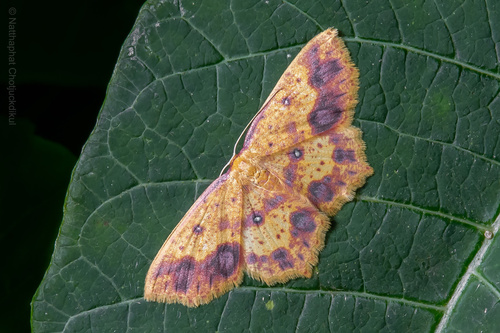
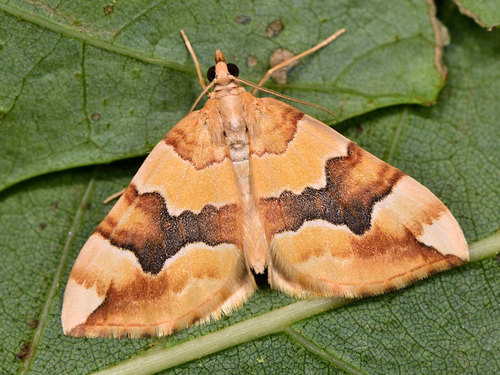
Cidaria fulvata, commonly called the barred yellow, is a moth in the Geometridae family. This species has a widespread distribution across the Palearctic region. In the west, its range extends from Spain and France to the British Isles; in the east it reaches as far as the Central Asian mountains, the Amur region, and Kamchatka. In the south, it stretches from Italy through Balkan countries, Asia Minor, the Caucasus, and the Caspian region all the way to the Pamir Mountains and northern India. In the north, its range extends to Fennoscandia. Its habitats include rocky slopes, heaths, wasteland, gardens, and parks. It also prefers woodland, chalk downland, and scrubland. The wingspan of Cidaria fulvata measures 20–25 mm. The forewings have a yellow or ochre base colour. They feature a wide rust-coloured cross band crossed by violet-grey markings. This cross band is jagged toward the wing margin, has thin cream-coloured edges, and is connected along the costa to a triangular cream-coloured stain at the wing apex. The hindwings are a plain whitish yellow. Full-grown larvae are rather long and slender, with two well-developed anal points. They are bluer green on the dorsal side, and yellower green on the ventral side, with a yellow lateral line. The head is rather small, and the prothorax is slightly swollen. The pupa is spun with a few threads among leaves. It is bright yellow green, with the wings taking on a more grass-green shade. The dorsal line is barely darkened, and there is a whitish subdorsal line. The cremaster is reddish. Adult moths fly from June to July. The larvae of this species feed on dog rose.