About Cicindela tranquebarica Herbst, 1806
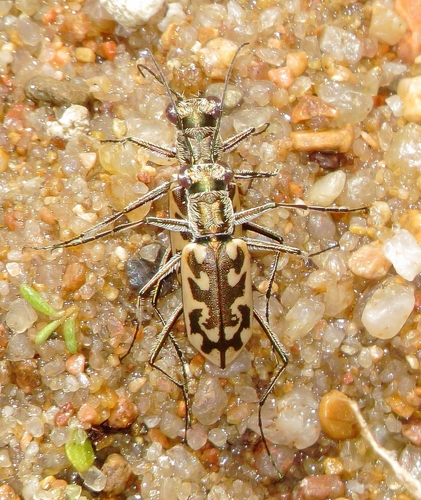
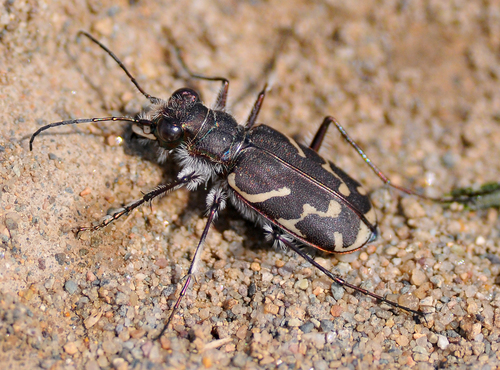
Cicindela tranquebarica (oblique-lined tiger beetle) varies widely in body color, ranging from reddish-brown to black to green. Overall body length for the species falls between 11 mm and 16 mm. A 2007 study recorded a mean body length of 11.8 mm for males (with a range of 11.1 to 12.2 mm), and a mean body length of 12.6 mm for females (with a range of 11.8 to 13.2 mm), so females of this species are observed to be slightly longer on average. This species has distinct coloration across different body regions: the abdomen is typically purple or black, the thorax is copper or dark red, and the head is red or purple. The forehead is hairy, with erect setae, and the short upper lip (labrum) has 3 teeth. Subspecies found in Montana usually have distinct, moderately to widely spread maculations, which appear as a light marking running down the body midline. The specific epithet tranquebarica is named for Tranquebar (now Tharangambadi, southern India), which was then a Danish colony. This location was incorrectly listed as the type specimen's origin on the label in German entomologist J. F. W. Herbst's collection, where the species was first described. Cicindela tranquebarica is distributed across most of the United States, ranging from the Atlantic Coast to the western slopes of the Sierra Nevada and Cascade mountain ranges. It is very common across many regions of Montana, with the highest relative population density in southwest Montana. Sightings are also frequent in southern California, scattered around the San Joaquin Valley. This species occupies a wide diversity of habitats, which can be wet, dry, dense, open, or have other environmental attributes. Documented habitats include banks and mud flats of creeks and rivers, dry lake beds, tidal flats, roadside ditches, packed gravelly-sandy roads near water, open ground, old fields, stubble fields, saline and alkali flats, blowouts, sand pits, prairie grasslands, forest trails, and roads. Populations in Montana have specifically been reported from sedge-grass sand flats, hard-packed gravelly-sandy roads near water, creeksides and ditches, saline/alkali flats, riparian dunes, sandy blowouts, sand pits, river sandbars, and old river crossings. Adult Cicindela tranquebarica are sensitive to light and heat, and are most active during sunny conditions. When temperatures become excessively hot, adults take shelter in vegetation or burrows. Larvae live in burrows, and molt through 3 instar stages before pupation; pupation also takes place inside a burrow. Adults may also stay in burrows: they typically use shallow soil burrows for overnight protection, and dig deeper burrows to live in during overwintering. The life cycle of Cicindela tranquebarica is essentially identical to that of Cicindela purpurea. Adults emerge in late spring, and lay eggs in June. First and second instar larvae can be found in early September. Larvae become much rarer and harder to find by late autumn. Larvae overwinter, then emerge in May or early June to enter their final instar stage. The full life cycle of Cicindela tranquebarica takes two years to complete.