About Cicindela sexguttata Fabricius, 1775
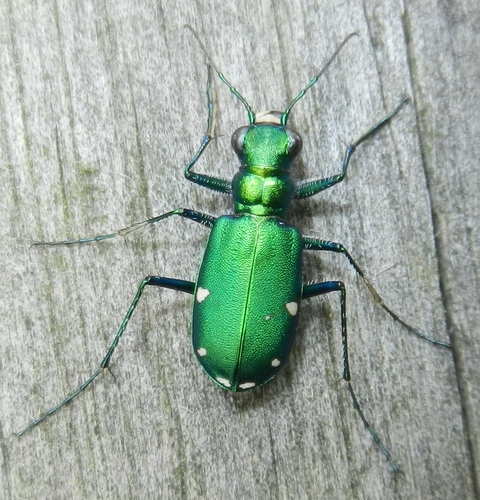
This species, Cicindela sexguttata, is commonly found in deciduous forests in a region spanning from Minnesota and southeastern Canada south to eastern Texas, and it is not found in the Florida Panhandle. It is easily recognizable by its large, white, overlapping mandibles. Adult individuals measure 12–14 mm (1/2-5/8") in length and have fairly long legs. The mandibles give these attractive insects a ferocious appearance. While this species of tiger beetle is a voracious predator of small arthropods, it will not bite humans unless it is handled. Both the common name and the species name refer to six small white spots on the beetle's metallic-green to metallic-blue-green elytra. This spot pattern is not consistent across all individuals: some may have more spots, fewer spots, or no spots at all, which is thought to be caused by genetic variation. This species is associated with wooded areas, and it is often found in sunlit, undergrowth-free clear patches such as dirt paths and fallen logs, where it hunts caterpillars, ants, spiders, and many other kinds of arthropods. Although these tiger beetles are not gregarious, many individuals may sometimes be found in a single suitable hunting area. Females lay their eggs in sandy patches. After hatching, larvae burrow into the ground, where they lie in wait for small arthropods to pass by. When prey approaches, larvae lunge out of their burrows to catch it. Beetles develop in the larval stage for about one year before pupating, and the species has a total lifespan of just under five years.