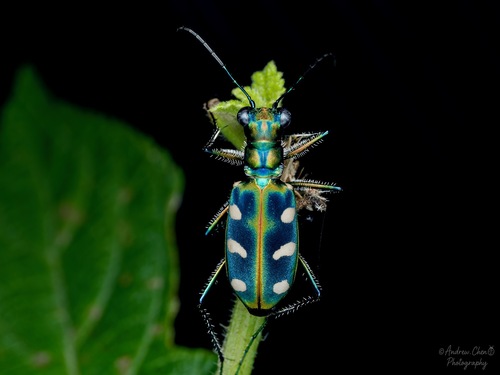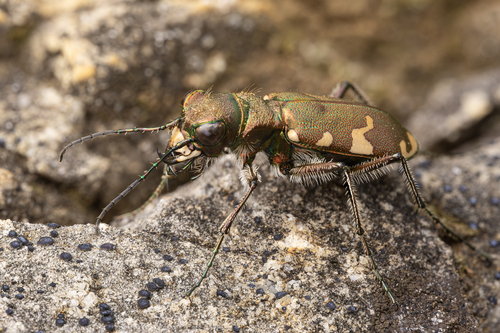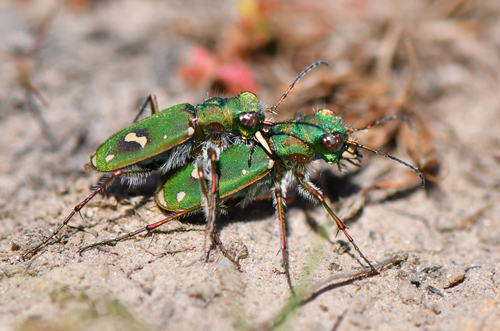
About Cicindela ohlone Freitag & Kavanaugh, 1993
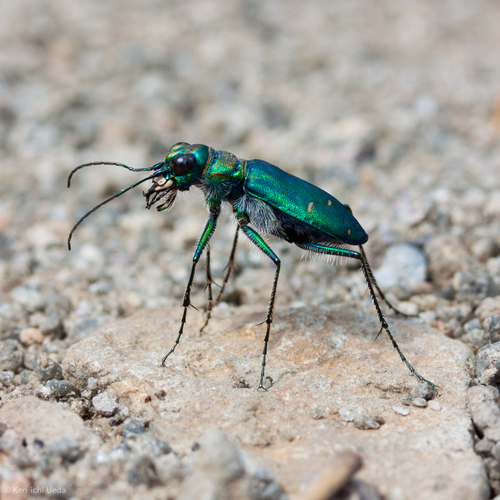
Cicindela ohlone, commonly known as the Ohlone tiger beetle, is endemic to California. It was first discovered in 1987, and was formally named and described in 1993 by Freitag and Kavanaugh. This species is most closely related to Cicindela purpurea. Adults of C. ohlone measure between 9 1/2 and 12 1/2 millimetres (0.37 to 0.49 inches) in length, with females falling on the larger end of this size range. Its body is a bright, silky-sericate green, with bronze tints on the upper dorsal surface and elytra. Compared to other members of the purpurea group, C. ohlone can be distinguished by its larger body size, distinct genital morphology, and different seasonal activity cycle. C. ohlone is strictly endemic to Santa Cruz County, California, which represents the southernmost habitat of any tiger beetle in the purpurea group. It is allopatric, meaning it occurs in a separate geographic range, from other members of the purpurea group. The species is found on coastal terraces, within remnant patches of native California coastal prairie grasslands. These sites have poorly drained clay or sandy clay soil overlying Santa Cruz mudstone. This soil compacts into a hard surface in late spring and summer, a key environmental feature that supports the beetle's activities. Open hard-packed soil areas are where the beetle carries out foraging, mating, and egg-laying. The full life cycle of C. ohlone takes two years to complete, though rare individuals complete development in one year. After mating and fertilization, the female deposits her egg several millimeters below the soil surface. When the egg hatches, the larva digs a vertical burrow. It waits in this burrow to ambush passing prey, feeds, and eventually pupates before emerging as a fully developed adult. C. ohlone is a predatory species that feeds on many different types of arthropods. It captures prey in one of two ways: either through active chases with brief intermittent pauses, or by waiting in shaded areas and grabbing approaching prey with its mandibles. The main predators of tiger beetles in general are birds, lizards, and other insects, though it has not yet been confirmed that C. ohlle shares this same set of predators. To escape predation, the beetle flees via quick short flights or running, aided by its exceptional vision. Predation on C. ohlone larvae specifically has not been studied, but general tiger beetle larvae are hunted by ground-foraging woodpeckers, ants, and wasps. The most significant predators of tiger beetle larvae are parasitoid wasps and flies, which lay their eggs inside the beetle larva. The hatching parasitoid larvae consume the tiger beetle larva from the inside, then eventually emerge as adult parasitoids from the burrow. Unlike all other tiger beetle species, which are active either in summer or in spring and fall, C. ohlone is only active during late winter and spring.