About Cicindela limbalis Klug, 1834
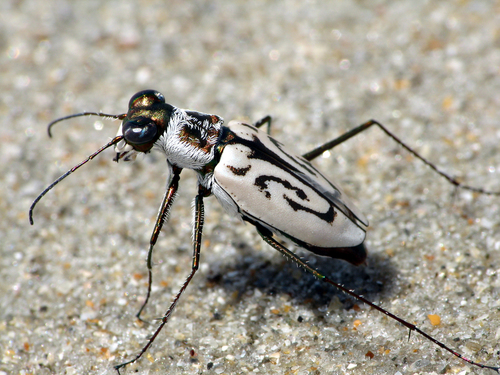
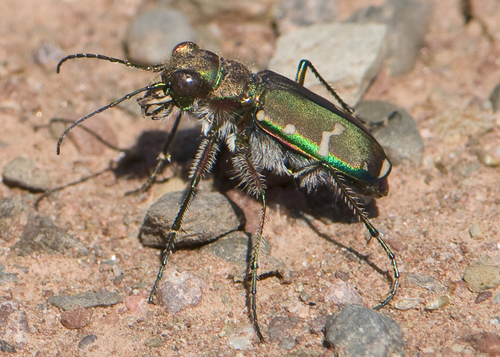
Cicindela limbalis Klug, 1834, commonly known as the common claybank tiger beetle, is a species of tiger beetle. Adults of this species measure 12 to 16 millimeters (0.5–0.6 inches) in length. Their dorsal surface is typically reddish purple, though it may sometimes appear dull green or brown. Individuals live for 3 years, and adults are most commonly found on steep, moist, bare clay soil. The common claybank tiger beetle is distributed across North America, east of the Rocky Mountains, ranging from the central-eastern North American coast through the northern half of the Great Plains. According to J. B. Wallis' book *The Cicindelidae of Canada*, the species has been recorded as far north as the Northwest Territories, near Tulita and Fort Wrigley in the Mackenzie River valley. There is a single recorded observation of this beetle from northern Yukon, on the Eagle River along the Dempster Highway. The Global Biodiversity Information Facility (GBIF) database holds a small number of records from the British Columbia Interior, south and west of Prince George, but Wallis did not document any records of the species from British Columbia. In Canada, the species is present in central and southern Alberta, mostly south of the Heart River; it is also found in central and southern Saskatchewan, mostly south of the North Saskatchewan River. In Manitoba, its distribution is limited to more southern areas, with recorded observations only from the Interlake region and areas further south. The species has a fairly wide range in Ontario, with records extending as far north as Smoky Falls. GBIF holds one observation near Summer Beaver, and numerous observations around Kapuskasing and Timmins. It is found across most of central and southern Ontario, though there are no recorded observations from the Bruce Peninsula. In Quebec, the species is generally found in and north of the Saint Lawrence Valley. There are records from around Opasatica Lake near the Ontario border at Highway 66/Route 117, and further north around the Harricana River. Wallis did not record the species from Gaspésie, Prince Edward Island, mainland Nova Scotia, or New Brunswick. GBIF records agree with the absences for Gaspésie and Prince Edward Island, but include numerous observations in New Brunswick and a small number of records from mainland Nova Scotia around Antigonish. The species is confirmed to occur on Cape Breton Island, and Wallis documents it from Bay of Islands, Newfoundland. In the United States, GBIF data shows a somewhat scattered distribution. The species occurs in New England, extending south to Virginia, and is found around the Great Lakes and the northern sections of the Mississippi and Missouri rivers. A large number of observations come from Colorado, mostly concentrated around the cities of Boulder and Fort Collins. It is recorded sparsely from the neighboring states of Wyoming, Montana, North Dakota, South Dakota, Nebraska, Kansas, and Oklahoma. There are no records from Kentucky or Indiana, even though the species has been observed in areas west, north, and east of both states. The southernmost record of the species in the GBIF database is from LeFlore County, Oklahoma. This beetle's specific habitat is bare clay slopes, most often located along river banks. Wallis notes that C. limbalis occupies an ecological niche dependent on steep clay slopes. He describes a 1908 experiment where collected individuals of this species were given a choice between clay and other soil types, and between steep and flat ground for reproduction. Both clay soil and steep inclines held far more larvae than the alternative options, with ratios of 46:1 for each preferred habitat characteristic.