About Cicindela aurulenta Fabricius, 1801
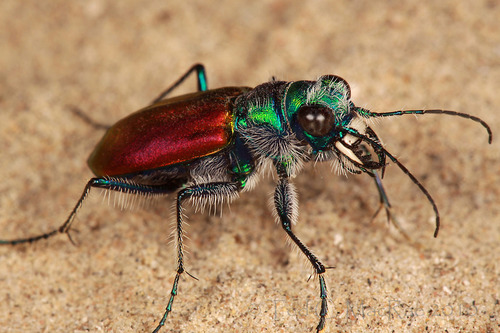
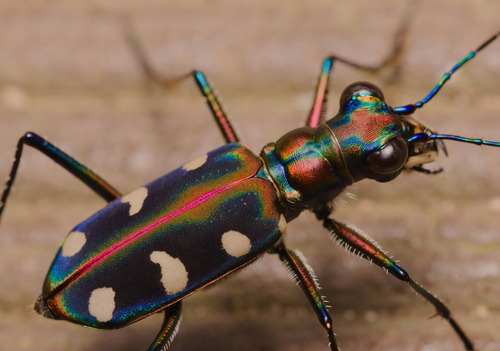
Cicindela aurulenta reaches approximately 15 to 18 millimetres (0.59 to 0.71 inches) in length. Members of this species have a polychromatic, iridescent external appearance. Their elytra are blue-green, marked with six large yellowish-white or bluish spots, plus two smaller spots on the shoulders. The middle large spot is somewhat more crescent-shaped than the anterior and posterior spots. The base and margins of the elytra appear reddish-orange. When viewed from above, the head and thorax are blue-green, and can show a red-orange appearance under certain lighting due to their iridescent coloration. This species has two prominent compound eyes and large mandibles that are predominantly black, with a yellowish-white marking at the base. The labrum is ivory-white with a black base and margins. The antennae are filiform: the scape, pedicel, and first two flagellomeres are blue-green, while the rest of the flagellum is dull black. Pale colored hairs grow on the abdomen and legs. C. aurulenta is widespread across the Indo-Malaya region. It is distributed across Nepal, Bhutan, India, China, and Southeast Asia. Its range extends as far south as the islands of Borneo, Sumatra, and the Lesser Sundas, including Bali. Multiple different subspecies co-occur within these regions. C. aurulenta can be found in a wide variety of sandy habitats, including river bars, forest trails, and sand dunes near shorelines and mangroves.