About Chunga burmeisteri (Hartlaub, 1860)
Scientific Classification and Size
The black-legged seriema, scientifically named Chunga burmeisteri (Hartlaub, 1860), is a large bird. It measures 70–85 cm (28–33 in) in length and weighs roughly 1.2 kg (2.6 lb), making it one of the largest ground-dwelling birds in the Neotropics; only the red-legged seriema and rheas are larger.
General Body Structure
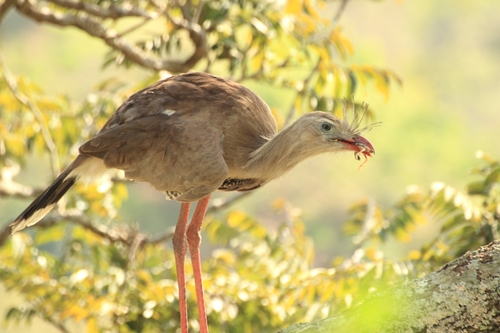
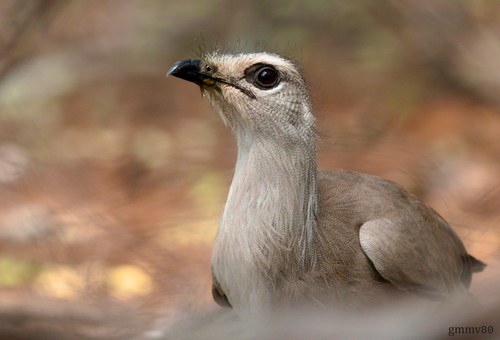
It has a long neck, long tail, very long slender legs, and short rounded wings. Its overall body color is ash-grey, but close inspection reveals the grey body feathers are finely vermiculated with black and white.
Crest Features
It has an inconspicuous frontal crest made of erect, hairlike bristles, and a second inconspicuous crest formed by particularly long feathers on its nape.
Head and Neck Markings
It has whitish supercilia and lores, and the feathers on its crown and nape are barred black and white.
Underparts Coloration
Its belly is paler grey, while its lower abdomen, crissum and thighs are yellowish-white.
Wing and Tail Markings
The flight feathers on its wings are heavily barred black and white, and its grey tail is barred with a narrow black tip.
Feather Texture
Its feathers are loosely webbed, which gives the bird a soft overall appearance.
Bill Characteristics
Its stout black bill has a strongly decurved culmen and a small hook at the tip.
Iris and Leg Color
The iris is reddish-brown, and the legs are dark-grey to black.
Foot Morphology
Its feet have three short front toes with very sharp claws, and one small elevated hind toe, a feature also found in Dromaeosauridae.
Adult Sexual Dimorphism
Male and female black-legged seriemas look identical to one another.
Juvenile Plumage
Juveniles are similar to adults, but have more patterning: their heads, necks and breasts are barred, and their backs and upperwing coverts are speckled with white.
Geographic Distribution
The black-legged seriema is found from southeastern Bolivia and northern Paraguay south into north-central Argentina.
Habitat Preferences
It is a dry-country bird that inhabits savanna, shrubland and dry open forest, including the Dry Chaco and the Monte Desert.
Bolivia Documentation History
The species was not documented in Bolivia until the late 1970s.
Elevation Range
It generally occurs at elevations below 800 m (2,600 ft), which is lower than the typical elevation range of the red-legged seriema.
Foraging Habitat Requirements
While it will forage in untreed areas such as cultivated fields and grassy plains, it only does so when wooded areas are nearby.
Diet Type
Black-legged seriemas are omnivorous.
Animal Prey Items
Insects, especially beetles and locusts, make up a large part of their diet, and they occasionally prey on rodents.
Plant Food Items
They also consume plant material, including leaves, grass and seeds.
Foraging Behavior
They often hunt near the feet of livestock, which are presumed to flush insects out as they move.