About Chrysothlypis chrysomelas (P.L.Sclater & Salvin, 1869)
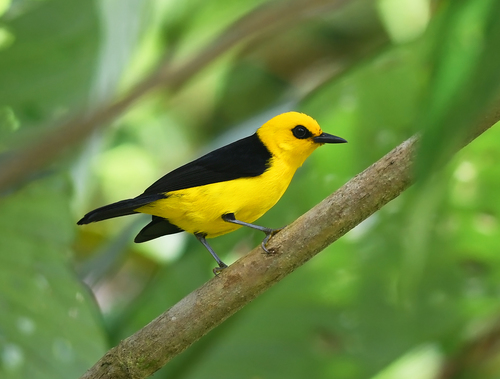
Chrysothlypis chrysomelas, commonly called the black-and-yellow tanager, has an adult body length around 12 centimetres (4.7 in) and an average adult weight of 12.5 grams (0.44 oz). Adult males have bright yellow heads, rumps, and underparts, with black backs, wings, and tails, and white wing linings. Males of the subspecies C. c. ocularis differ from the nominal subspecies by having a black spot on the lores. Females have olive upperparts and yellow underparts; in populations from Costa Rica and extreme western Panama, sometimes recognized as the subspecies C. c. titanota, the throat and lower belly are whitish. Female black-and-yellow tanagers can be mistaken for warblers or female yellow-backed tanagers. Immature individuals resemble adult females. This species is distributed in Central America and far northwestern South America. In Costa Rica, it occurs on the Caribbean-side foothills and slopes of the central mountain ranges, generally at altitudes between 600 and 1,200 metres (2,000 to 3,900 ft), and occasionally as low as 400 metres (1,300 ft). In Panama, it has been recorded as far east as the country's border region with Colombia, and occurs on both the Caribbean and Pacific slopes at altitudes from 450 to 1,200 metres (1,480 to 3,940 ft). In 2010, a family group of this tanager was reported in Colombia's Chocó department, near the Panamanian border. Its preferred habitat is the canopy of wet forest and tall second growth, but it will feed at lower levels at woodland edges and clearings. Black-and-yellow tanagers typically occur in small groups, or join mixed-species feeding flocks. This species feeds on small fruit (usually swallowed whole), insects, and spiders. It builds a neat cup-shaped nest on a tree branch, and its eggs have not been formally described.