About Chrysopsis delaneyi Wunderlin & Semple
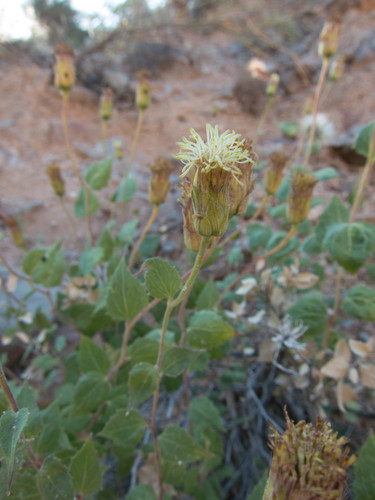
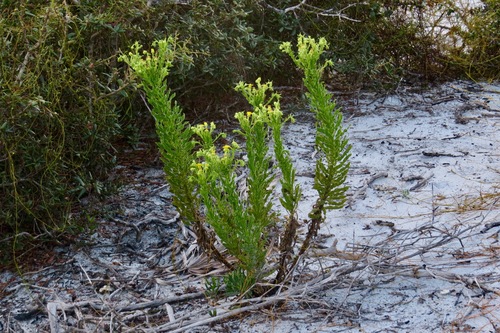
Chrysopsis delaneyi Wunderlin & Semple is both morphologically and genetically variable. It forms a complex of ecotypes and/or varieties that are associated with, and adapted to, Florida's major ridges and discrete upland systems. This species is primarily restricted to four major metapopulations: the Lake Wales Ridge (LWR), Orange County Ridge (OCR), southern Atlantic Coastal Ridge (ACR), and a system of geologically younger, lower ridges located between LWR and ACR. The ridges referenced here follow the description and mapping published by William White in his 1970 work Geomorphology of Florida, USGS. Chrysopsis delaneyi was formally described in 2003, and named to honor its discoverer. While it can be locally abundant at some small sites, the species is classified as highly endangered due to the near-complete loss of its original habitat. Morphological and genetic analysis indicates that the metapopulations of C. delaneyi may actually represent distinct taxa, which likely arose from genetic bottlenecking followed by long-term, island-like biogeographic isolation. The species' discoverer, Kris DeLaney (born 1951), has found many other new plant species in central Florida, including a second golden aster, C. highlandsensis, also called the Highlands County goldenaster. Chrysopsis delaneyi is endemic to Florida, where it is highly endangered and has a very restricted range. By the mid-20th century, most of its original longleaf pine/turkey oak sandhill habitat had been cleared for corporate citrus farming. Most species in the Chrysopsis genus are endemic to Florida, limited to relatively small regions of the state's well-drained sandy ridges. C. delaneyi grows in dry, nutrient-poor xeric upland ecosystems, including sand pine scrub and longleaf pine/turkey oak sandhills. It is a weakly perennial plant, bright green in color, tall and leafy, and produces large "lettuce-like" rosettes. The entire plant is covered in viscid, resin-producing glandular-stipitate trichomes (hairs). Bright yellow flowers grow at the tops of leafy stems that can reach up to 1.5 m tall; the flower heads range from approximately 2.4 cm to 5.0 cm in diameter.