About Chrysomyxa arctostaphyli Dietel
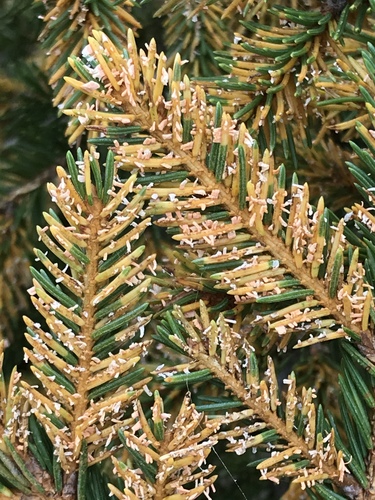
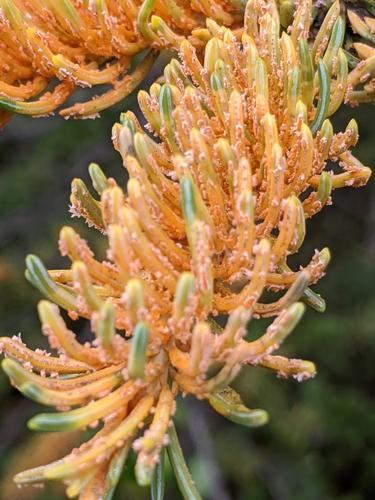
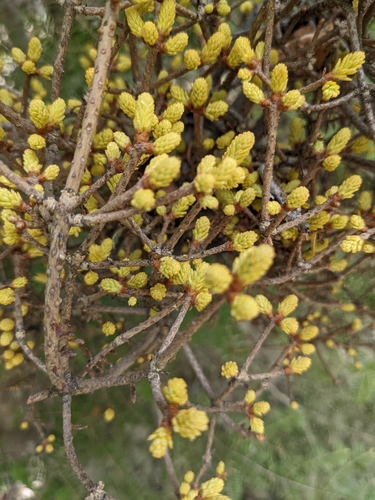
Spruce broom rust (also called yellow witches' broom rust) is a fungal plant disease caused by the basidiomycete fungus Chrysomyxa arctostaphyli. This disease occurs exclusively in North America. Its most concentrated outbreaks are on blue and Engelmann spruce in northern Arizona and southern Colorado, and on black and white spruce in Alaska. The disease has a heteroecious life cycle that alternates between two hosts: spruce acts as the primary host, and bearberry (also known as kinnickinnick) acts as the secondary or alternate host. The disease gets its name from the distinctive, commonly yellow "witches broom" growth that forms on spruce after young needles become infected. No chemical control measures such as fungicides have yet been found to be economically effective, so management must be done through physical or mechanical methods, like pruning affected brooms or removing the alternate bearberry host from the area. Generally, spruce broom rust is mostly a cosmetic issue and very rarely directly causes tree death. However, research shows it reduces the overall productivity and health of infected trees, making it an important concern for logging and timber companies. In spring, the intense odor released by spermogonia on infected spruce needles attracts insects, which cross-fertilize the fungus. This fertilization allows aecia to form, which in turn produce aeciospores. Spruce broom rust is common in the western United States, particularly in the Rocky Mountain Region where it infects Colorado blue spruce, and in the boreal forests of Alaska and Canada where it parasitizes both white and black spruce. Initially, researchers did not recognize the connection between bearberry and spruce as alternate hosts for this fungus, because bearberry had not been documented growing at the high altitudes where spruce grows in the Rocky Mountains. It was even originally hypothesized that the spores found on bearberry came from a microcyclic rust that only infected bearberry and had no alternate host. Eventually, researchers discovered that bearberry can grow at altitudes similar to those where spruce grows, and C. arctostaphyli was even found growing on bearberry at these altitudes. It was later confirmed experimentally that when bearberry was inoculated with aeciospores from spruce brooms in a moist chamber, telia began to form on the bearberry.