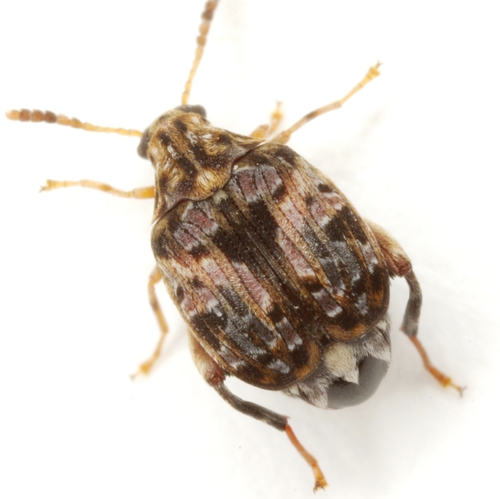
About Chrysomela populi Linnaeus, 1758
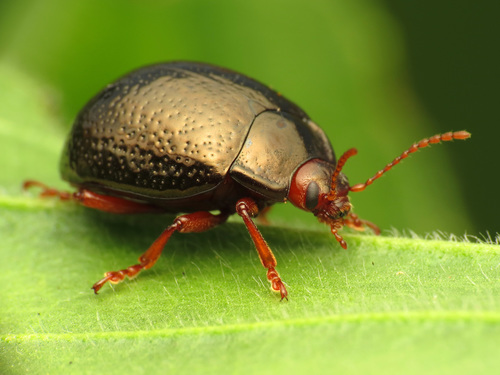
The larvae of Chrysomela populi Linnaeus, 1758 are white or light grey with black dots. Adult Chrysomela populi reach a length of approximately 9–13 mm, with females slightly larger than males. These beetles have a round, ladybird-like body that is black, dark blue, or dark green. The head and pronotum are black, while the elytra are bright red with a black stain at the base; some individuals are orange. This species can be distinguished from Chrysolina grossa by its shorter antennae and less extensive pronotum, and it is rather similar to Chrysomela saliceti and Chrysomela tremula.
Chrysomela populi is one of the most widespread and common leaf beetle species in the subfamily Chrysomelinae. It can be found across most of Europe (including Austria, Belgium, Czech Republic, France, Germany, Italy, Luxembourg, Poland, Slovakia, Switzerland), the Palearctic realm, and the Oriental realm (including Caucasus, Pakistan, Siberia, Kazakhstan, Central Asia, the Far East of Russia, China, and Japan). These beetles mainly inhabit coniferous, mixed and broad-leaved forests, forest fringes, and dry meadows that host poplars and willow trees. They have been recorded living on the willow species Salix repens, Salix caprea, Salix cinerea, and Salix alba, and have also been observed on many sapling species, primarily Populus tremula, as well as Populus canescens, Populus nigra, Populus Canadensis, and Populus maximowiczii. Chrysomela populi larvae mature into adults year round. The species overwinters under the bark and leaves of host species, and is rarely active before April. Populations peak from May to August and remain abundant until September or October.
Adults can be found from April to October. Females lay eggs in spring, in small irregular clusters of up to 20–30 eggs. This species produces 2 to 3 generations per year. Larvae of the last generation overwinter in leaf litter. Chrysomela populi mates in spring after a feeding period where adults chew large round holes in the foliage of developing host plants. Oviposition begins soon after mating and continues into early summer. Eggs are laid in batches on the underside of leaves; these batches average around 20 eggs, and larvae emerge 10 days after eggs are laid. Larvae feed on the underside of leaves, stripping them completely, and develop into adults within a month after passing through 3 instars. Mature third-instar larvae pupate on the underside of leaves of the host plant or neighboring plants. New adults emerge in autumn, enter diapause, feed, and then overwinter near the host plant. In laboratory conditions at 25 degrees Celsius, the mean adult longevity was observed to be longer than 50 days for both sexes. New generations of adults continue to emerge from late June into September. Adults feed throughout the summer but do not mate until after they have overwintered.
The female reproductive system of Chrysomela populi consists of a pair of ovaries, a pair of lateral oviducts, a common oviduct, and a spermatheca. Each ovary holds 14 light yellow ovarioles that expand from the distal to the proximal end. From distal to proximal, the parts of an ovariole are the terminal filament, germarium, vitellarium, and pedicel. Previtellogenic, vitellogenic, and chorionic oocytes are arranged linearly inside the vitellarium. Chrysomela populi eggs are light yellow and elongated, measuring approximately 1.6 mm long and 0.6 mm wide. The male reproductive organs are located dorsolateral to the median region of the body, and include a pair of testes, a pair of vasa deferentia and vasa efferentia, two seminal vesicles, a pair of accessory glands, an ejaculatory bulb, an ejaculatory duct, and an aedeagus. The testes are approximately 1.8 mm long and 1 mm wide, separated into two lobed sections. Each testis has 20 sperm tubules covered by a light orange peritoneal sheath. Within each testicular follicle, different regions correspond to different germ cell development stages: the growth zone (upper region holding spermatogonia), the maturation region (where spermatogonia divide and become encapsulated), and the transformation zone (where spermatogonia develop into spermatids and mature spermatozoa).
Both larvae and adult Chrysomela populi live and feed on the young leaves of various plants in the Salicaceae family, especially Populus and Salix species. Adults can emit a strong-smelling red repellent liquid derived from salicylic acid from their food plants. The overall mortality of Chrysomela populi from larva to adult is significantly affected by food source. One study on the correlation between food source and Chrysomela populi development and mortality found that beetles living on genetically crossed clones of Populus tremula x Populus tremuloides (tt) had the lowest average mortality compared to populations on clones of Populus alba and Populus alba x Populus tremula (ta). Mortality rates on Populus alba clones were higher, though these rates decreased from the first generation to the second. Regarding development time, offspring reared on Ptt clones took longer on average to reach adulthood than those on the other two clones, and progeny on Pta clones had a significantly longer development time than those on Populus alba clones. Adult body weight was also affected by the rearing plant: insects that fed on Populus alba were significantly lighter than those on the other clones, while insects that fed on Ptt clones were the heaviest. Heavier body weight gives a selective advantage, as increased body weight increases fecundity in female Chrysomela populi. The study also found that beetles reared on Populus alba had significantly shorter longevity compared to the other groups. Progeny reared on Populus alba had an average mortality rate of 42 percent, rising up to 70 percent after 35 days of experimentation. Progeny reared on Ptt had an average mortality rate of 2.5 percent, ranging up to 27 percent. Progeny reared on Pta fell in an intermediate range, with an average mortality rate of 27 percent ranging up to 42 percent. Females feeding on Ptt laid significantly more eggs, averaging 24.7 to 33.9 eggs per female per day. In contrast, those feeding on Pta averaged 2.5 to 16.2 eggs per female per day. Females feeding on Populus alba laid only a few eggs or none at all, as beetles reared on Populus alba did not live long enough to reach peak egg production.