About Chrysolina herbacea (Duftschmid, 1825)
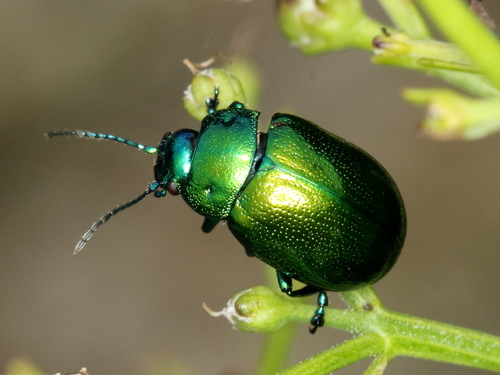
Chrysolina herbacea, commonly known as the mint leaf beetle, is typically a bright metallic green species, though some individuals have a gold-purple sheen. Colour variation occurs across specimens, especially females, which can range from golden-red to deep blue. The beetle’s legs and pronotum match its base body colour, and it has antennae. This is a large beetle with a long, oval shape; adult individuals measure 8–10 mm in length. Adults have fully formed wings, but only fly rarely. Larvae of this species are black, and both larvae and adults feed on mint leaves. Visually, the mint leaf beetle can be misidentified as the much rarer tansy beetle (Chrysolina graminis), as well as Cryptocephalus hypochaeridis and Chrysolina coerulans. This species is distributed across the European islands of Great Britain and Ireland, European countries including Portugal and Romania, and also occurs in the Caucasus, Turkey, western Central Asia, and North India. Mint leaf beetles favour a range of wet habitats, most notably damp riverside areas and marshy fields, and can also be found in woodland, parkland, and gardens. Their preferred host plants belong to the family Lamiaceae, particularly mints. Across most of its range, the species is active from May through September. In the United Kingdom, adult beetles first emerge in April or May, become abundant by late May or early June, and remain active through the entire summer. Adults lay eggs in May and June, and larvae hatch in mid to late June. Larvae feed throughout the summer, then overwinter. They become active again and feed for a short period in April, after which they pupate in soil. Adult mint leaf beetles are long-lived, and may overwinter up to two times.