About Chrysolepis chrysophylla (Douglas ex Hook.) Hjelmq.
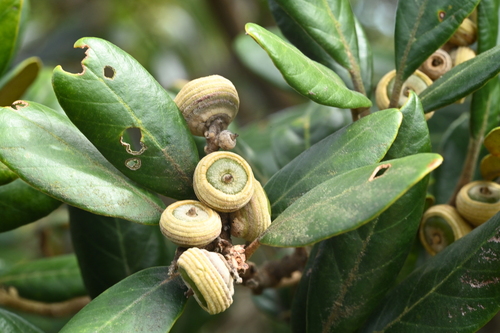
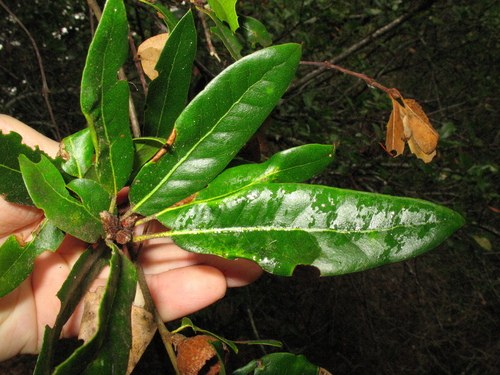
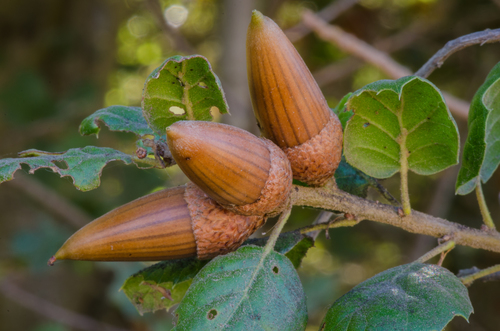
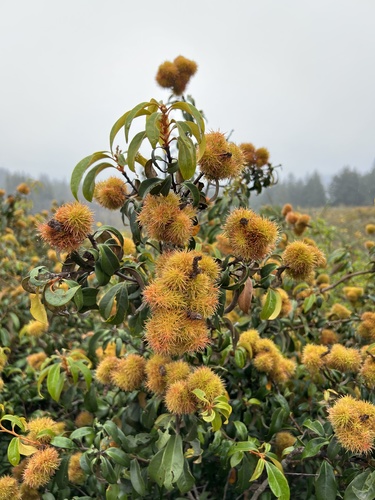
Chrysolepis chrysophylla (Douglas ex Hook.) Hjelmq. grows as a shrub in dry areas, at higher elevations, and on poor soils. In cooler, moister sites including valley bottoms, north-facing slopes, and foggy, rainy regions, it grows into a tree reaching up to 45 metres (148 ft) tall. Tree trunks can reach a maximum diameter of 90 centimetres (35 inches). Young trunks have thin, smooth reddish bark, which becomes thicker and platy on older individuals. Large mature trees have an open, conically shaped crown. The evergreen leaves are leathery, dark green on their upper surfaces, and golden on the undersides. Each leaf measures 5 to 13 cm (2 to 5 in) long and is folded upward along its midrib. This species is monoecious: individual plants bear both male and female flowers. White male flowers grow from leaf axils, with a cluster of female flowers growing below these male flowers. A spiny bur holds one to three nuts, each around 1 cm in diameter. There is typically a burl at the base of the tree. The tree can sprout from adventitious buds in this burl, a method of vegetative reproduction that is more common in dry areas, where seedlings are less likely to become established. Individual trees can live up to 500 years. This species looks similar to tanoak, but produces chestnut-like fruit instead of an acorn. Chrysolepis chrysophylla is endemic to the Pacific coast of the United States, with a range extending from extreme southern Washington through western Oregon, and south to west-central California. It grows in climax forests dominated by redwood, white fir, western hemlock, or Shasta red fir, as well as in mixed stands of these tree types. It can grow as an understory shrub, or as a tree that codominates the forest canopy. It can be found in a range of habitat types, including coastal forests, woodlands, and chaparral. In the western Cascade Mountains, it grows in western hemlock forests. In the southern Cascades, it grows at higher elevations and develops a smaller, shrubbier form. It can grow at elevations up to 1,800 m (5,900 ft) above sea level. In ecology, the tree form of this species is shade intolerant, so it requires occasional disturbances to reproduce. In contrast, the shrub form can tolerate shade and is largely unaffected by disturbances. Older trees often develop heart rot. The nuts are commonly eaten by squirrels and chipmunks. The wood of this tree is heavy and strong, light brown with a pinkish tinge. It rarely grows in large enough quantities to be used for commercial purposes. The nut is edible, with a flavor similar to hazelnut or filbert, and it was consumed by Native Americans.