About Chrysochus cobaltinus LeConte, 1857
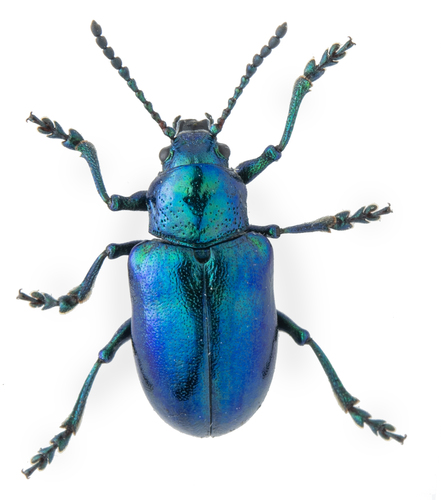
Chrysochus cobaltinus, commonly called the cobalt milkweed beetle or blue milkweed beetle, is a species of leaf beetle in the family Chrysomelidae. Its common name references two key traits: its distinct cobalt-blue exoskeleton, which makes it easy to identify, and its habit of feeding on milkweed plants. This species is found in the Western United States and British Columbia. Its primary food sources are milkweed and dogbane plant species. Both of these plant groups contain toxic compounds called cardenolides. C. cobaltinus is resistant to the toxic effects of cardenolides, and stores these toxins in glands in its pronotum and elytra to use for its own protection against predators, gaining an evolutionary benefit from this adaptation. This species practices polygamy, where both females and males mate with multiple partners. Females are able to mate with three males at the same time. After mating, males typically remain mounted on the female’s back for an average of 1.7 hours. This postcopulatory behavior is thought to increase the male’s chance of siring offspring that carry his paternal genes. While the original male stays mounted, he prevents the female from mating with other males until he dismounts. C. cobaltinus also engages in hybrid mating with its sister species, Chrysochus auratus. In areas where the two species live close together, this interbreeding has led to genetic introgression between the two species. C. cobaltinus’s range covers the High Plains, extending from British Columbia south through Washington, Idaho, Montana, Oregon, California, Nevada, Utah, and Colorado, all the way to Arizona and New Mexico. East of the Rocky Mountains, C. cobaltinus is replaced by Chrysochus auratus. Historically, these two species were thought to have allopatric (non-overlapping) distributions. However, narrow hybrid zones where both C. auratus and C. cobaltinus occur and interbreed have been found in western North America. One well-documented hybrid zone is a 25-kilometer wide zone in Washington state’s Yakima River valley. In these hybrid zones, individuals of both species can be found on the same host plant, and interbreeding between the two species has been observed. A second potential hybrid zone occurs in Kamloops, British Columbia, where both species have been collected, and local beetles show intermediate physical characteristics that suggest introgression between C. cobaltinus and C. auratus. A number of other locations (including areas in Utah) have beetles with differing physical characteristics that may point to hybrid mating, but this has not yet been confirmed. Adult C. cobaltinus emerge in early summer, and remain in patches on milkweed plants for approximately six weeks. Females are highly polyandrous, and males carry out extended post-copulatory mate guarding. Adult females lay their eggs on the leaves of dogbane and milkweed plants. After hatching, larvae consume leaf tissue between the leaf veins, leaving only a leaf skeleton behind. Occasionally, larvae will also eat the plant’s root system. Large groups of C. cobaltinus larvae can consume all of a plant’s leaves. This does not appear to kill the plant, which simply goes dormant until the following year. However, if larvae consume the plant’s root system, the plant will eventually die.