About Chrysilla lauta Thorell, 1887
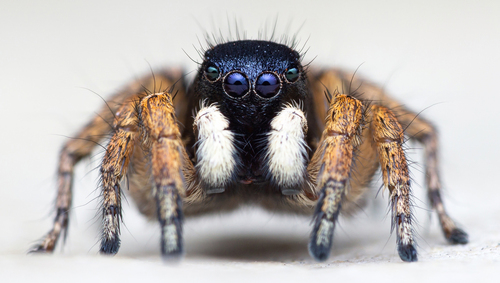
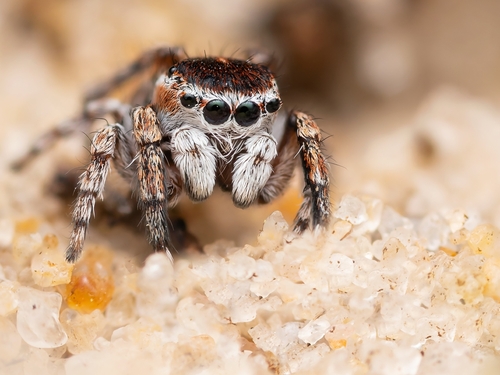
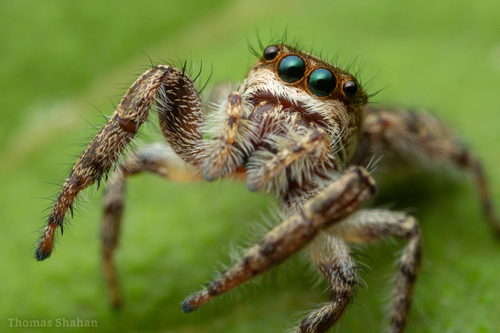
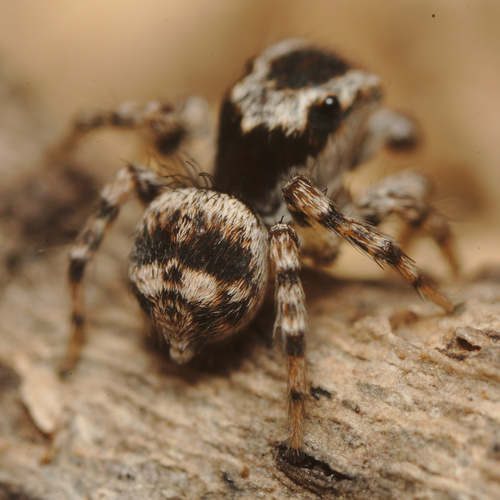
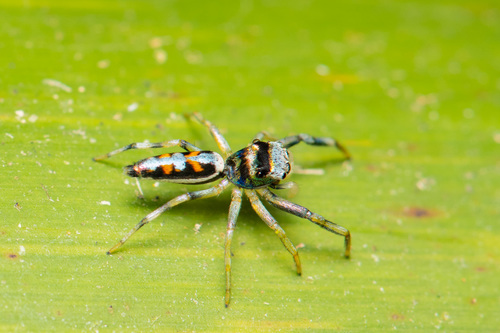
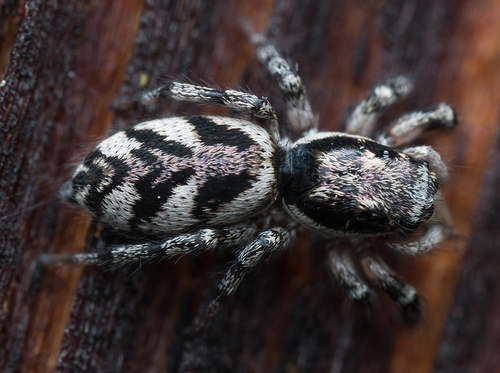
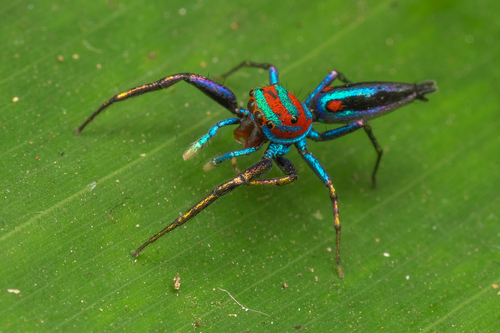
Male Chrysilla lauta Thorell, 1887 are very slender. Their carapace is orange-red, with a narrow, bluish-white iridescent transverse stripe positioned between the eyes. Their robust chelicerae do not point forward. The long scutum covering the opisthosoma is dark brown, and is covered in dense, bronze-colored hairs. Their long legs are brownish-yellow, with the first pair of legs and the last segments of the other legs brown. Females are smaller than males, with an average body length of 5.0 mm. In live females, parts of the carapace are covered in white setae, and the abdomen has a pattern made up of red, white, black and iridescent greenish spots. This coloration varies considerably between individual specimens. Female chelicerae have parallel sides, with one distal tooth on the promargin and two distal teeth on the retromargin. All female legs are pale in color. The female abdomen has few iridescent scales that form a faint, vague dorsal pattern. Lateral patches are made up of reddish procumbent hair, and the posterior half of the abdomen has dark areas covered in simple black setae arranged into several reversed V-shaped bars. This species is generally found in forests and gardens, typically collected by beating or sweeping shrubs and trees, and occurs from lowland areas up to an elevation of 600 m.