About Chrozophora tinctoria (L.) A.Juss.
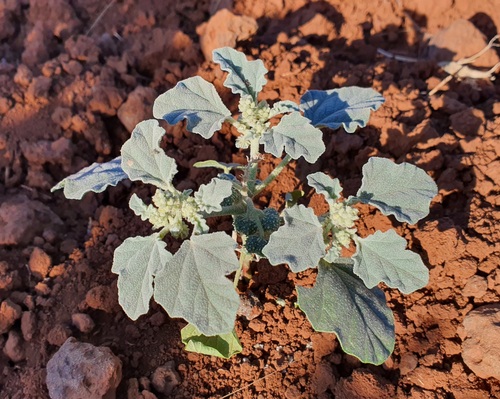
Chrozophora tinctoria (L.) A.Juss. is an annual plant that typically grows in nutrient-poor soil. It develops a large taproot, grows erect, and is covered in wool-like hairs. Its ash-green leaves are arranged alternately. Tiny monoecious flowers are clustered in racemes: lower female flowers have no petals, while upper male flowers have five small yellow petals. This species is pollinated by ants. Its fruits are easy to spot, made up of three connected dark green spheres. The fruit surface is covered with white scales and warty growths. Each sphere holds three seeds, which are ejected away from the parent plant by mechanical force from the twisting of the mature fruit as it opens. Chrozophora tinctoria is classified as a poisonous plant; eating it may cause stomach upset, vomiting, nausea, and diarrhoea.
Historically, this plant was used to produce the blue-purple colorant called "turnsole" (also known as katasol or folium). This colorant was used in medieval illuminated manuscripts, and as a food colorant in Dutch cheese and certain liquors. It was most often used as a cheaper substitute for Tyrian purple, the well-known dye obtained from Murex molluscs. The color comes from the plant's fruit, specifically its dry outer coat. The colorant can also be obtained from translucent sap found in the plant's cells when leaves are broken off and exposed to air. Different shades of blue and purple can be produced when juice extracts are exposed to ammonia (NH3) vapour. In late 19th century France, this ammonia was produced by applying fresh horse manure and urine to fabric soaked with the plant extract. The plant was also historically used across the Levant to dye clothing. 100 kilograms (220 lb) of the plant produces 50 kilograms (110 lb) of sap, which is enough to dye 25 kilograms (55 lb) of fabric rolls. In 2020, an interdisciplinary research team from FCT NOVA, the University of Porto, and the University of Aveiro identified the complex chemical structure of the medieval purple-blue dye extracted from the fruits of Chrozophora tinctoria. The chemical structure of this medieval dye was unknown before this study. Extracts revealed that a new blue chemical, chrozophoridine, is the dye's main chromophore.