About Chroogomphus tomentosus (Murrill) O.K.Mill.
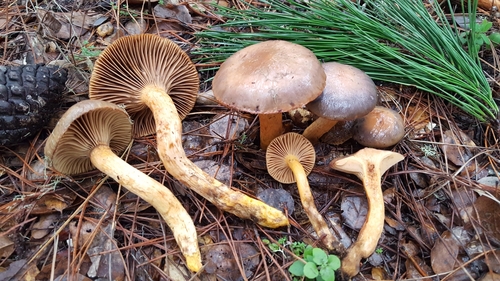
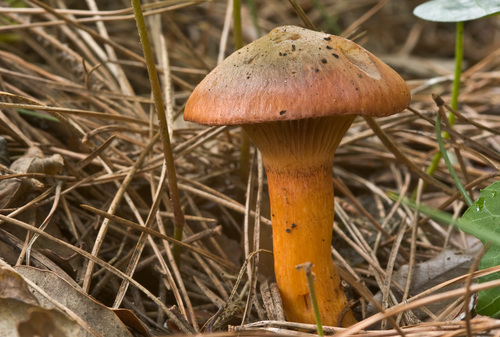
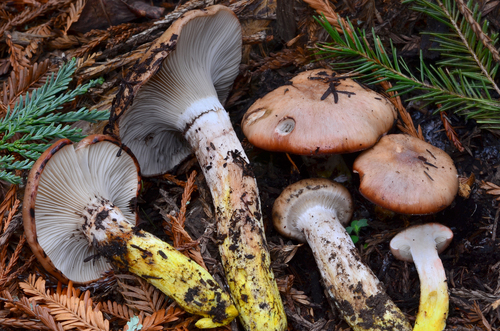
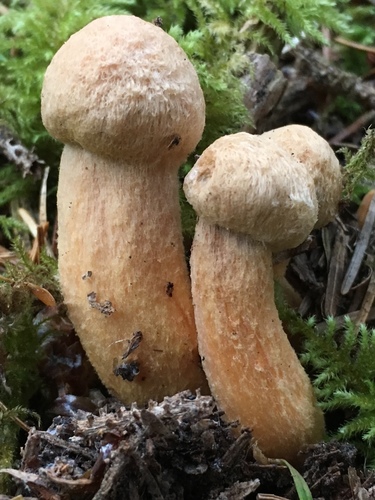
The scientific name of this fungus is Chroogomphus tomentosus (Murrill) O.K.Mill. The cap of Chroogomphus tomentosus begins as a peg-like shape. As it matures, it becomes conical, umbonate, convex, or flat. The cap surface is fibrillose. Unlike other mushrooms in its group, which typically have viscid caps, Chroogomphus tomentosus does not have a viscid cap. The cap is orangish in color, and measures about 3 to 10 centimeters in diameter. The stipe measures about 5 to 15 centimeters long and 0.5 to 1.5 centimeters wide. The gills are most often decurrent, and start out a color similar to the cap. As the mushroom ages, the gills turn tan or brownish. The spore print of Chroogomphus tomentosus is gray or blackish. Chroogomphus tomentosus is found in forests containing western hemlock, and is commonly found near rotting logs. It forms an association with the admirable bolete (Aureoboletus mirabilis), a mycorrhizal fungus that forms a symbiotic relationship with hemlock trees. It is likely that C. tomentosus is parasitic on A. mirabilis. This species begins fruiting in summer, and continues fruiting into winter.