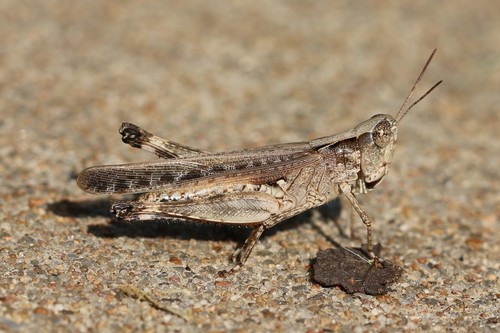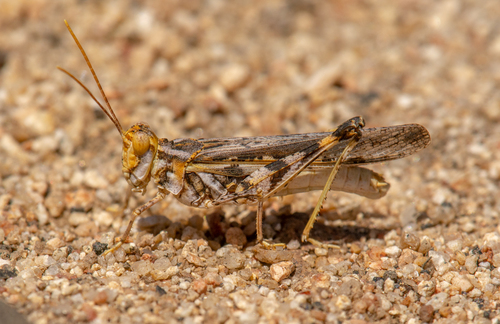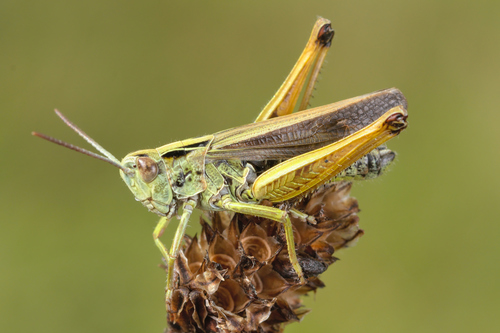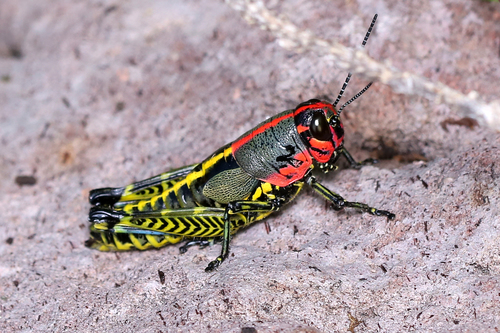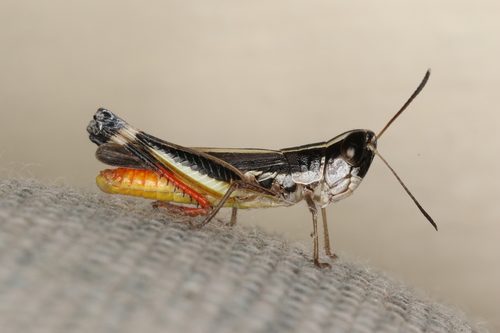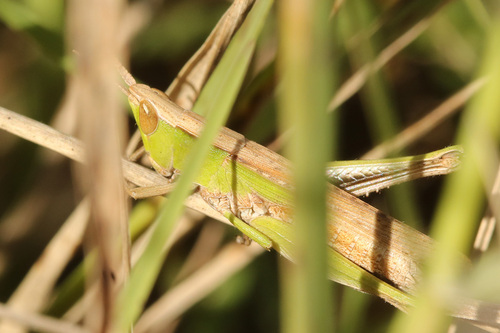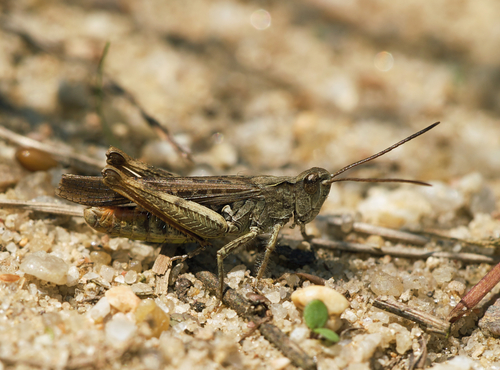
About Chorthippus brunneus (Thunberg, 1815)
Chorthippus brunneus, also commonly called the common field grasshopper, is a grasshopper species belonging to the subfamily Gomphocerinae. This species is common and widespread across the Western Palearctic, and the IUCN has assessed its conservation status as Least Concern. C. brunneus occurs across Europe, north Africa, and temperate Asia. It favors dry habitats, and is found in higher population numbers in heathland areas than in agricultural areas. This population difference can be attributed to differences in sward height between the two habitat types. C. brunneus prefers habitats with sward heights between 100 and 200 mm, as well as fine-leaved grass species. There is a documented positive correlation between C. brunneus presence and abundance, and both Agrostis grass species and Festuca grass species. Fine-leaved grasses and taller swards are more common in heathlands, which experience far less human land alteration than agricultural sites. Sward height directly impacts C. brunneus abundance: greater numbers of this grasshopper are found in taller swards, though some scientific literature notes that C. brunneus also thrives in wastelands. Vertebrate grazing also affects C. brunneus population density by altering sward height. Areas that are not grazed have higher C. brunneus densities than grazed areas. Vertebrate grazing is thought to change plant hormone levels; two of these hormones, abscisic acid and gibberellins, are known to affect C. brunneus fecundity. Grazing also triggers the production of proteinase inhibitors in plants, and alters plant nitrogen levels. In areas with lower levels of vertebrate grazing, C. brunneus shows faster development rates, higher adult body weights, and increased fecundity. C. brunneus is univoltine, meaning it produces one generation per year.