About Chorizanthe orcuttiana Parry
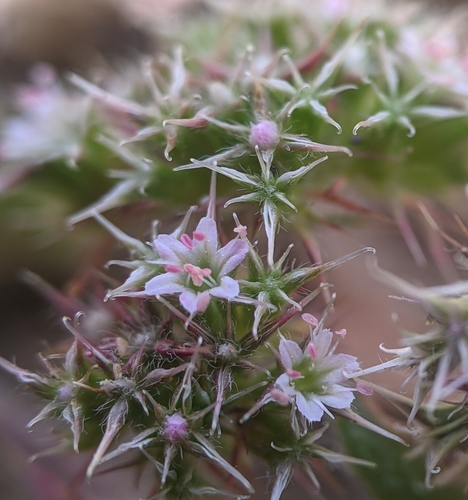
Chorizanthe orcuttiana Parry is an annual herb that grows in a prostrate growth habit, and the entire plant is covered in dense, white, silky hairs. Before flowering (anthesis), its basal leaves form a rosette 0.5 to 5 cm (0.20 to 1.97 in) in diameter. The most common leaf shape is narrowly oblanceolate, measuring 0.5 to 1.5 cm (0.20 to 0.59 in) long by 0.2 to 0.35 cm (0.079 to 0.138 in) wide, with an acute tip. Different individuals of this species can display two distinct leaf forms: one is oblanceolate with an obtuse leaf apex and a reddish tinge on the upper leaf surface, while the other has slightly elongated leaves. All leaves attach to the plant via a pubescent petiole. The inflorescence of this species is cymose. Awns may be present on the inflorescence, and when present, they usually measure 0.6 to 1 mm (0.024 to 0.039 in) long. Involucres grow in small clusters approximately 0.5 to 1 cm (0.20 to 0.39 in) across. There are 2 opposite bracts on each structure. In some plants, one of the two bracts is typically laminar, oblanceolate, and awnless, while the opposite bract is greatly reduced and ends in a short, straight awn. The involucres themselves are campanulate in shape, 3-angled, 3-ribbed, and greenish in color. They have faint transverse ridges, 3 teeth, and hooked awns. The involucre tubes are 1.8 to 2 mm (0.071 to 0.079 in) long and pubescent. Flowers first emerge in tight bundles at the center of the basal rosette, with each individual flower enclosed inside an involucre. Individual flowers measure 1.5 to 1.8 mm (0.059 to 0.071 in) across, are covered in dense hair, and have a yellow perianth. There are 9 stamens attached at the top of the floral tube, with reddish anthers. Anthesis occurs in February, and within 30 days after anthesis, the plants begin to branch. Branched mature plants are significantly larger, reaching between 1 and 17 cm (0.39 and 6.69 in) in diameter. This species often grows alongside other similar small plants, including Mucronea californica and Camissoniopsis bistorta, which can make identification difficult when plants are still in their vegetative growth stages. M. californica has rosettes of elongated leaves, but these typically have rounded or truncated leaf apices, are only slightly papillate, and have hairy leaf edges. C. bistorta occurs in a wider range of sizes, with a mean rosette size of around 2 to 3 cm (0.79 to 1.18 in). C. bistorta is easier to distinguish because its leaves are typically more purplish-gray, covered in dense, white, coarse pubescence, have a purple underside, and have an acute leaf apex. This plant requires open coastal habitat, such as sandstone bluffs and openings in maritime chaparral. All known occurrences of this species are within five kilometers of the coastline. It grows on white sand soils that are neutral or somewhat acidic, and low in organic material. These substrates originate from iron-rich sandstone. Between 82% and 93% of San Diego County's historical maritime chaparral habitat has been destroyed for development and damaged by human activities such as recreation, leaving just over 3000 acres of this habitat remaining.