About Chlosyne lacinia (Geyer, 1837)
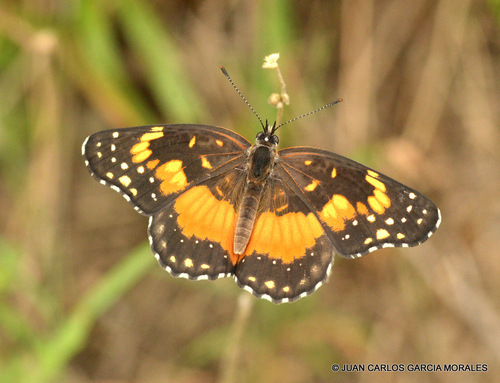
Chlosyne lacinia, commonly called the bordered patch, is an extremely variable butterfly species. On the upper side of its wings, the base color is mainly black. The forewing has rows of white and/or yellow-orange spots of varying sizes, and usually has one whitish spot in the forewing cell. The hindwing shows many distinct color variations, ranging from almost completely black, to having some red postmedian spots, a few rows of white postmedian spots, an all red-orange discal area, or a yellow-orange postmedian band of varying width. The underside of the wings is just as variable as the upper side. Variations on the underside range from having a few rows of white and red spots, to a yellow-white hindwing median band of varying width, to being mostly golden yellow with large yellow-orange spots and a thick golden-yellow median band. All of these variations share a consistent feature: a red spot near the hindwing tornus. The wingspan of this butterfly ranges from 1 1/4 to 1 7/8 inches (32 to 48 mm).
The bordered patch can be found in desert hills, mesquite woodlands, pinyon woodlands, and oak woodlands across the United States. In the US, the species prefers agricultural areas and weedy wastelands where its preferred host plant, Helianthus annuus, grows. In Belize, Costa Rica, Panama and other Central American regions, this species and other members of its genus are often found on roadside verges, in unmowed rows between citrus plantations, and other disturbed ground areas. In these locations, both nectar resources and larval hosts come from plant species in the Asteraceae, Acanthaceae, and Amaranthaceae families.
For its life cycle, males wait for females on hilltops to mate. Females lay eggs in clusters of about 100 or more on the underside of host plant leaves. The eggs are pale yellow-green when first laid, and later turn reddish. Young larvae feed together but do not create a nest, and become solitary as they mature. Like the adult butterfly, the larva is highly variable: it can be mostly orange with black spines and stripes, black with a red-orange mid-dorsal stripe, or almost all black. All larval variations have a red-orange head. The chrysalis also varies in color, from almost entirely white, to white with black markings, to nearly all black. The third instar larva hibernates and also estivates, and the bordered patch produces three or four broods per year.