About Chlosyne janais (Drury, 1782)
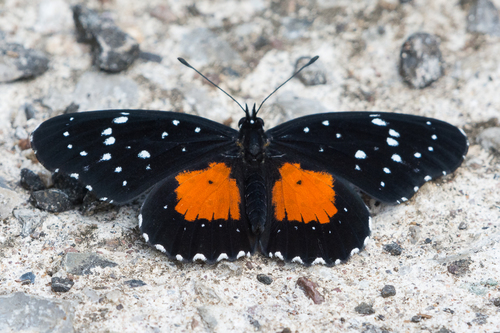
Chlosyne janais, commonly known as the crimson patch or janais patch, is a common New World butterfly. Its distribution ranges from Colombia northward through Central America and Mexico to southern Texas, with occasional sightings recorded in southeastern Mexico and northern Texas. Both the dorsal and ventral wing surfaces of this butterfly are black, with several undulating rows of small white spots on the medial forewings and along all outer wing margins. Each dorsal hindwing has an anteriorly located medial orange-red patch. On the ventral hindwings, there is a fragmented yellow proximal patch, which is bordered by a thick postmedial red band that does not extend to the wing margins. The maximum wingspan of Chlosyne janais measures between 4.8 and 6.7 cm. Adult butterflies live on the periphery of lowland tropical to subtropical forests, in fields, and along streams, and they feed on flower nectar. In tropical regions, this species reproduces continuously, while in temperate areas, it produces several generations of broods from July to November. The caterpillars range in color from grey white to green, and have several transverse rows of fleshy black spines. They feed primarily on acanthus shrubs, especially Anisacanthus wrightii and Odontonema callistachus in Texas, and adult females lay their eggs on these host shrubs. In the Rio Grande Valley, crimson patch populations can reach high numbers, but cold snaps periodically kill off local populations; the area is then recolonized by individuals from Mexican populations. A very closely related species is the rosita patch, C. rosita, which can be distinguished from the crimson patch by the rosita patch's lack of spots on the wing margins.